

Stop wasting your marketing budget on traffic that hits a dead end. If your current PPC campaigns feel like a high-speed chase toward a low-revenue cliff, you aren’t alone. Most teams spend far too much time obsessing over “fiddly bits” whilst ignoring the fundamental psychological triggers that turn a click into a customer. High Conversion Landing Pages are not the result of artistic flair; they are the product of precision engineering and a deep understanding of search intent. Since 2007, I’ve seen countless businesses burn through cash because their SEO keywords and on-page content are speaking two different languages.
It’s maddening to watch your cost-per-acquisition climb whilst your internal teams focus on aesthetics rather than revenue drivers. I’m going to share the precision-engineered framework for landing pages that bridge the gap between search intent and measurable growth. You’ll discover how to align your search strategy with web design that actually converts. We’ll even look at why a mere one-second delay in page load can slash your conversions by 7 per cent. We’re moving past the fluff to give you a roadmap to find, convince, and convert with total authority.
Key Takeaways
- Move beyond superficial “fiddly bits” by adopting a strategic “Find, Convince, Convert” framework that treats your website as a precision-engineered environment for revenue.
- Learn how to close the gap between search intent and on-page content, ensuring your landing page serves as the logical conclusion to every user’s specific query.
- Understand the psychology of “Believable Branding” and how establishing immediate authority makes your commercial claims more credible to a skeptical audience.
- Discover the technical non-negotiables for High Conversion Landing Pages in 2026, focusing on sub-second load speeds and a radical mobile-first design philosophy.
- Explore the “Digital Road Map” strategy that ensures your marketing spend translates into measurable ROI through senior director-level accountability.
Beyond Aesthetics: The Strategic Architecture of High Conversion Landing Pages
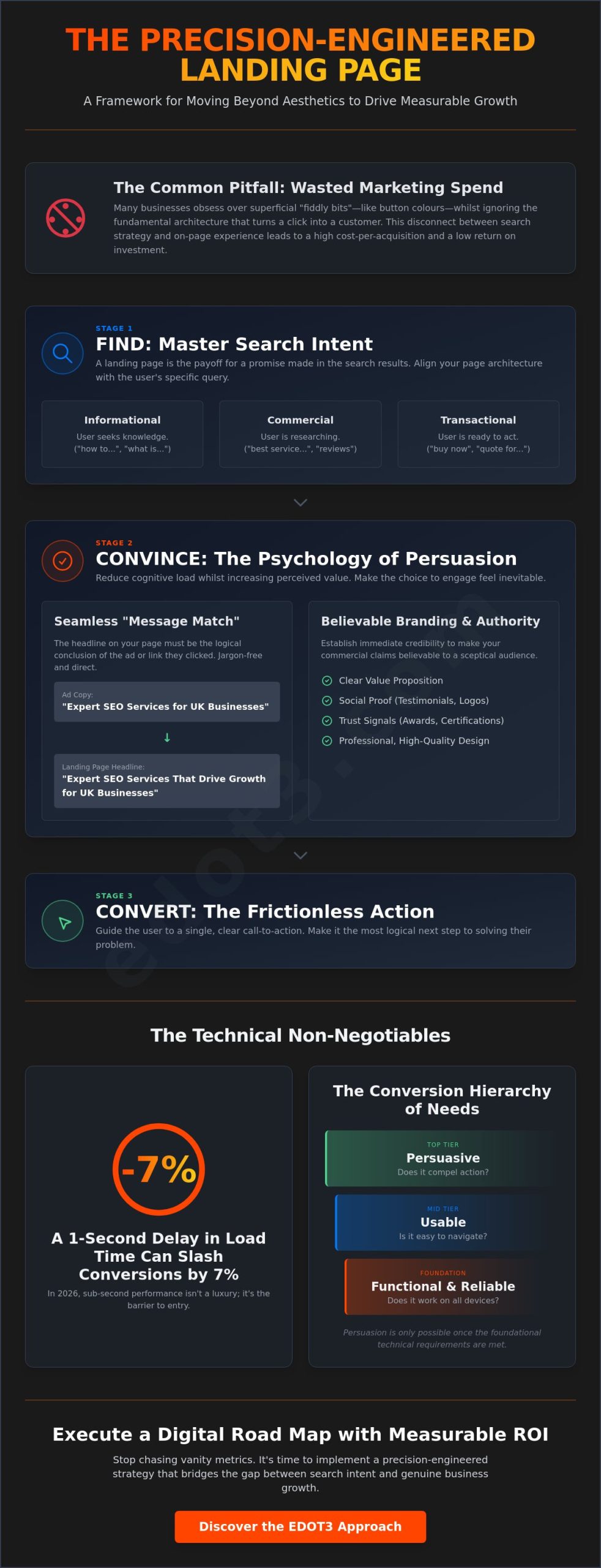
Most digital agencies are obsessed with the wrong things. They’ll spend weeks debating the exact shade of cerulean for a call-to-action button whilst your bounce rate bleeds your budget dry. High performance is not born from artistic whims; it is the result of precision-engineered environments built for one specific user action. We must strip away the superficial “fiddly bits” to focus on exceptional foundations. This is where Landing page optimization (LPO) becomes less about decoration and more about strategic architecture.
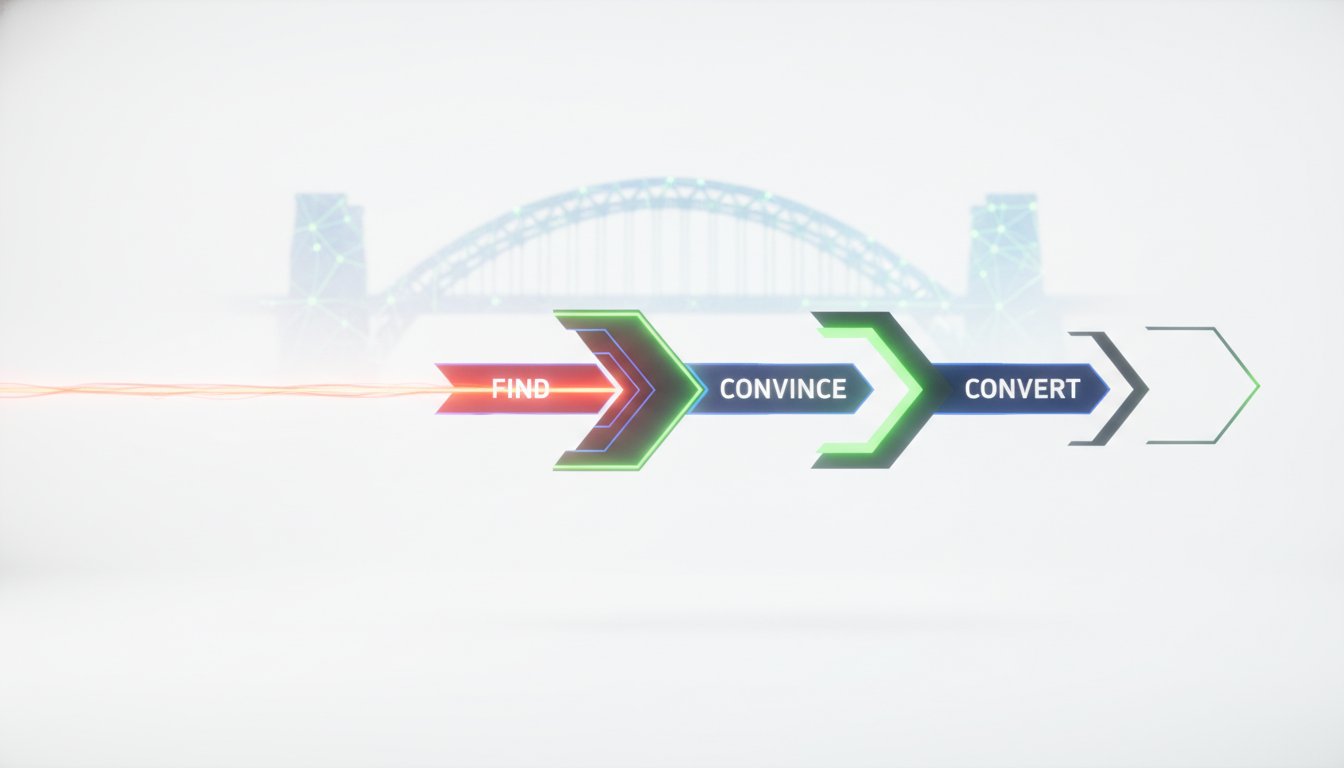
The philosophy of a successful page is simple: Find, Convince, Convert. You cannot have one without the others. If your search strategy finds the traffic but your page fails to convince the visitor of your authority, the investment is wasted. The objective is to reduce cognitive load whilst simultaneously increasing perceived value. You want the visitor to feel that staying on your page is the most logical, low-effort path to solving their problem. It is about making the choice to engage feel inevitable rather than forced through aggressive sales tactics.
To better understand how these architectural elements come together in practice, watch this breakdown of high-performance design:
The ROI of Strategic Conversion Design
Moving the needle by even 1 per cent can have a staggering impact on your annual marketing budget. It isn’t just a marginal gain; it is a compounding force that amplifies every pound spent on acquisition. By 2026, savvy businesses have stopped chasing vanity metrics like “sessions” or “impressions” that don’t pay the bills. Instead, the focus has shifted to meaningful interactions and qualified leads. High Conversion Landing Pages in the current market require a level of brand maturity that generic templates simply cannot provide. You need conversion design that acts as a silent, high-performing closer for your sales team.
Foundations over Fads: What Actually Drives the Click
There is a hierarchy of needs that dictates whether a visitor stays or strays. It starts with being functional and reliable; if the page breaks on mobile or fails an accessibility check, the opportunity is lost. Then it must be usable. Only after these technical requirements are met can the page truly become persuasive. The foundational ROI of a landing page is the intersection of technical speed and messaging clarity. Generic “best practices” often fall flat for niche UK B2B service businesses because they ignore the specific nuances of a skeptical audience. You don’t need a fad; you need a framework that respects the user’s time and intelligence.
The Search Intent-Conversion Loop: Aligning “Find” with “Convince”
Most search marketing strategies fail because the discovery phase and the conversion phase operate in total isolation. A landing page isn’t just a destination; it’s the payoff for a promise made in the search results. If your page isn’t the logical conclusion of the search query that brought the user there, they’ll bounce. High Conversion Landing Pages succeed because they close the loop between what a user wants and what you provide. This requires a seamless “Message Match” that is entirely jargon-free. If an ad promises a solution and the page delivers a generic corporate manifesto, the lead is lost before they’ve even scrolled past the header.
Intent generally falls into three primary buckets: Informational, Commercial, and Transactional. Each requires a different architectural response. You cannot treat a researcher looking for a “how-to” guide the same way you treat someone ready to sign a contract for the “best service in London.” Search-First Architecture ensures that the layout of the page is dictated by search data rather than creative ego. The environment must be built around the user’s existing mental model, making the transition from the SERP to the site feel like a natural continuation of their thought process.
Mapping Keywords to Page Layouts
AI Search Optimisation has fundamentally changed the game by 2026. It allows for the prediction of exactly what information a user needs to see first based on massive datasets of search behaviour. Generative Search means users often arrive on your page having already seen a summary of your offering in an AI-generated snippet. Your landing page must now work harder to provide the depth and authority that an AI overview cannot replicate. If you’re still using generic templates that don’t address these specific data points, you’re essentially invisible to your target market. Your layout should reflect the complexity of the query, providing quick answers for informational intent and deep proof for commercial intent.
The Authority Gap: Closing the Trust Deficit
Every search query carries an inherent objection. If someone is looking for a specialist, they are secretly asking, “Are you actually an expert, or just good at marketing?” You must address this trust deficit before the fold. Use data-driven insights to determine which trust signals move the needle for your specific audience. For some, it’s industry accreditations; for others, it’s granular case studies that prove a return on investment. This is the core of being a strategic digital agency in 2026. You don’t just ask for the click; you earn it by being the most believable authority in the room. If your current pages feel more like a sales pitch than a solution, it’s time to audit your search strategy and fix the disconnect between what you find and how you convince.
The Psychology of Believable Branding in Conversion Design
Aesthetics without psychology are just pretty pictures that don’t sell. In a skeptical UK market, “Loveable Branding” is your only shield against the “back” button. When a visitor lands on your page, the “Halo Effect” takes over almost instantly. If your brand identity suggests authority and professional maturity, your commercial claims become significantly more believable. This isn’t about chasing UI trends on Dribbble; it’s about building High Conversion Landing Pages that respect the intelligence of your audience.
We focus on “Believable Branding” because it beats aggressive, “salesy” copy every single time. For high-ticket services, desperate language is a red flag. Instead, we utilise the four pillars of persuasion: Social Proof, Authority, Scarcity, and Reciprocity. These triggers work beneath the surface to reduce friction and make the conversion feel like the visitor’s own idea. You aren’t just selling a service; you are positioning yourself as the definitive solution to their specific business pains.
Social Proof: Beyond the Five-Star Rating
The era of the anonymous five-star rating is over. To win in 2026, you need “Deep Social Proof.” This involves video testimonials, verified case studies, and PR-SEO mentions that prove you exist in the real world. Anonymity is a conversion killer. If you don’t show real faces and real results, you’re just another faceless entity in a crowded SERP. Organise your social proof so it supports specific value propositions; don’t just dump a wall of text at the bottom of the page and hope for the best.
Visual Hierarchy and the “Z-Pattern” of Persuasion
Your layout should guide the eye through a predictable path, often following the natural “Z-pattern” of Western reading habits. We use colour, contrast, and negative space to ensure the primary Call to Action is never missed. The “Hero Section” is your most valuable real estate. Within 3 seconds, a visitor must know exactly what you do, who you do it for, and why they should care. Visual Authority is the strategic application of professional typography and bespoke imagery to signal undeniable market leadership. When these elements align, your High Conversion Landing Pages stop being static documents and start becoming revenue-generating assets.
Technical Foundations: Speed, Mobile-First, and the UK Authority Gap
Technical foundations are the “exceptional foundations” that separate a hobbyist site from a revenue machine. You can have the most persuasive copy in the world, but if your page takes three seconds to load, half your audience has already vanished. By 2026, the benchmark for High Conversion Landing Pages has shifted to sub-second load times. We aren’t just talking about a minor tweak to your CSS; we’re talking about a radical commitment to performance that satisfies both Google’s algorithms and the dwindling patience of your prospects.
The “UK Authority Gap” often stems from a failure to address local regulatory and technical standards. Whilst many agencies use generic US-based hosting, we prioritise UK-based data centres to slash latency and ensure GDPR-compliant lead capture. This isn’t just about legal tick-boxes; it’s about the psychological security of your user. Google’s 2026 updates have amplified the importance of a composite Core Web Vitals score, specifically focusing on Interaction to Next Paint (INP). If your page feels sluggish or unresponsive during a mobile interaction, your bounce rate will skyrocket, and your search rankings will follow it down.
The Cost of a Slow Page
The data is brutal. According to verified industry research, a one-second delay in page load time can reduce conversions by 7 per cent. Conversely, pages that load in under one second see conversion rates three times higher than those taking five seconds. This technical SEO performance is directly tethered to your bottom line. It’s why we dismiss “fiddly bits” in favour of clean, high-performance code. To understand how this fits into your broader brand strategy, see our insights on Professional Branding Services: A Director’s Guide to Building Authority in 2026.
Local Authority Signals for UK Businesses
Trust is local. For a UK-based client, seeing a Newcastle or London address alongside a .co.uk domain creates an immediate sense of accountability. We use local trust markers, such as trade body memberships and domestic case studies, to bridge the trust deficit. Believable Branding must feel like it belongs in the same time zone as the customer to be truly effective. If your landing page feels like a generic “global” template, you’re leaking authority. We ensure every technical signal, from your hosting location to your lead form behaviour, screams domestic expertise. If your current technical setup is dragging down your ROI, it’s time to book a technical health check for your landing pages.
Executing the Digital Road Map: The EDOT3 Approach to ROI
Strategy without execution is just expensive daydreaming. At EDOT3, we don’t deal in vague promises or “fiddly bits” that look nice but fail to convert. We provide a Digital Road Map. This is our proven six-step process that takes your business from initial Discovery through to measurable, hard-hitting ROI. We’ve been in the game since 2007, and we know that High Conversion Landing Pages are only effective when they are part of a broader, high-energy growth engine. We combine your Branding, SEO Strategy, and Web Design into a single, cohesive unit designed to dominate your search space.
Our approach is built on “Exceptional Foundations.” We strip away the distractions to focus on the core drivers of revenue. This isn’t just about getting you to the top of the SERPs; it’s about ensuring that once you’re found, you have the authority to convince and the technical precision to convert. We take a holistic view of your digital presence, ensuring that every element of your page is pulling its weight. If a design choice doesn’t contribute to your bottom line, it doesn’t make the cut. It’s about lean, aggressive, and highly effective marketing.
Why Seniority Matters in Conversion Strategy
Stop settling for transient employees who might disappear mid-campaign. When you work with us, you get direct Director-level contact. You deal with senior strategists who have spent nearly two decades refining what actually works in the UK market. This seniority ensures a level of accountability that junior account managers simply cannot provide. We protect your investment by being aggressive toward your competitors and protective of your brand’s authority. We don’t just follow industry norms; we challenge them to ensure your business stays ahead of the curve.
Start Your Conversion Journey Today
The “Find, Convince, Convert” framework is the foundational philosophy that drives everything we do. It’s time to move past superficial aesthetics and start building a digital presence that actually performs. Whether you’re struggling with high acquisition costs or a disconnect between your keywords and your content, the solution starts with a clear, strategic plan. We invite you to take the first step toward a more profitable future. Stop guessing and start growing. You can begin the process and Get Optimised For Success with an EDOT3 Digital Health Check to see exactly where your current strategy is leaking revenue.
Optimise Your Foundations for Measurable Growth
Stop wasting your marketing budget on landing pages that look pretty but perform poorly. You now have the framework to build High Conversion Landing Pages that bridge the gap between search intent and measurable revenue growth. By aligning your technical foundations with believable authority and a deep understanding of user psychology, you move beyond the “fiddly bits” and start driving real ROI. It is about creating a logical conclusion for every search query and respecting the intelligence of your audience.
Since 2007, I’ve been helping businesses in Newcastle, London, and across the UK navigate the complexities of digital marketing. My team and I specialise in the “Find, Convince, Convert” methodology, providing senior Director-level strategy that actually moves the needle. We don’t hide behind junior account managers; we partner with you to ensure every click counts toward your bottom line. We are passionate about protecting your investment and outperforming your competitors with exceptional foundations.
It’s time to stop guessing and start scaling with precision. Take the first step toward a more profitable search strategy today. Book Your Digital Health Check with EDOT3 and let’s identify the specific gaps in your conversion loop. Your competition isn’t waiting, and neither should you. Let’s get your digital roadmap rocking it.
Frequently Asked Questions
What is a good conversion rate for a landing page in 2026?
A good conversion rate in 2026 typically sits between 4.02 per cent and 6.6 per cent, which represents the median across most industries. However, elite performers in the top 25 per cent often achieve rates of 10 per cent or higher. In the B2B sector, we frequently see even better performance, with averages reaching 13.3 per cent. Our goal with High Conversion Landing Pages is to push your results into that top tier by focusing on exceptional foundations rather than industry averages.
Do I need a different landing page for every SEO keyword?
You don’t need a unique page for every individual keyword, but you must group them by search intent. Creating specific environments for Informational, Commercial, and Transactional queries ensures your “Message Match” remains airtight. If a user clicks an ad for a specific service and lands on a generic homepage, they’ll bounce. We align the “Find” and “Convince” stages of our framework to ensure the page feels like the logical conclusion to the user’s specific search.
How long should a high-conversion landing page be?
The length should be dictated by the complexity of your offer and the level of skepticism in your market. High-ticket UK B2B services usually require longer pages to house “Deep Social Proof” and address complex objections. Conversely, a simple lead magnet might only need a punchy hero section and a single form field. The objective is always to provide enough authority to make the conversion feel inevitable whilst ruthlessly stripping away any “fiddly bits” that increase cognitive load.
Can I use a website builder for high-conversion pages?
You can use a website builder, but you must be wary of the technical bloat that often drags down performance. High Conversion Landing Pages require sub-second load times to meet 2026 performance standards and satisfy Google’s Core Web Vitals. Many builders include unnecessary scripts that hinder speed and mobile responsiveness. If you use one, ensure it allows for deep technical optimisation and UK-based hosting to maintain the speed and authority required to convert a skeptical audience.
What is the most important element on a landing page?
The most critical element is the “Hero Section” and its immediate alignment with search intent. A visitor must understand your value proposition and why they should trust you within three seconds of landing. If your headline and primary imagery don’t mirror the promise made in the search results, the user will leave. This is the “Convince” stage in action; you must establish immediate, believable authority before the user even considers scrolling down the page.
How do I track the ROI of my landing pages?
Track ROI by connecting your lead capture data directly to your CRM and final sales revenue. Move past vanity metrics like “sessions” or raw conversion rates. You need to know the specific lifetime value of a lead generated from your landing page compared to your marketing spend. This level of transparency is central to our “Digital Road Map” approach, ensuring every action taken is part of a larger strategy to drive measurable business growth rather than just traffic.
Should I include my navigation menu on a landing page?
Generally, you should remove the standard navigation menu to eliminate potential “leaks” in your conversion funnel. A landing page is a precision-engineered environment designed for one specific action. Providing links to your “About Us” or “Blog” pages creates distractions that pull users away from the primary CTA. By removing these exits, you force the visitor to focus on the information provided, which significantly increases the likelihood of them completing the desired transaction.
How does mobile-friendliness affect my conversion rates?
Mobile-friendliness is vital because mobile devices now account for approximately 65 per cent of all landing page traffic. Despite this volume, mobile conversion rates often lag behind desktop, averaging around 2.8 per cent compared to 4.8 per cent. Closing this gap requires a radical “Mobile-First” conversion path rather than a simple responsive layout. If your mobile experience is sluggish or your forms are difficult to complete on a small screen, you are effectively ignoring two-thirds of your potential leads.