

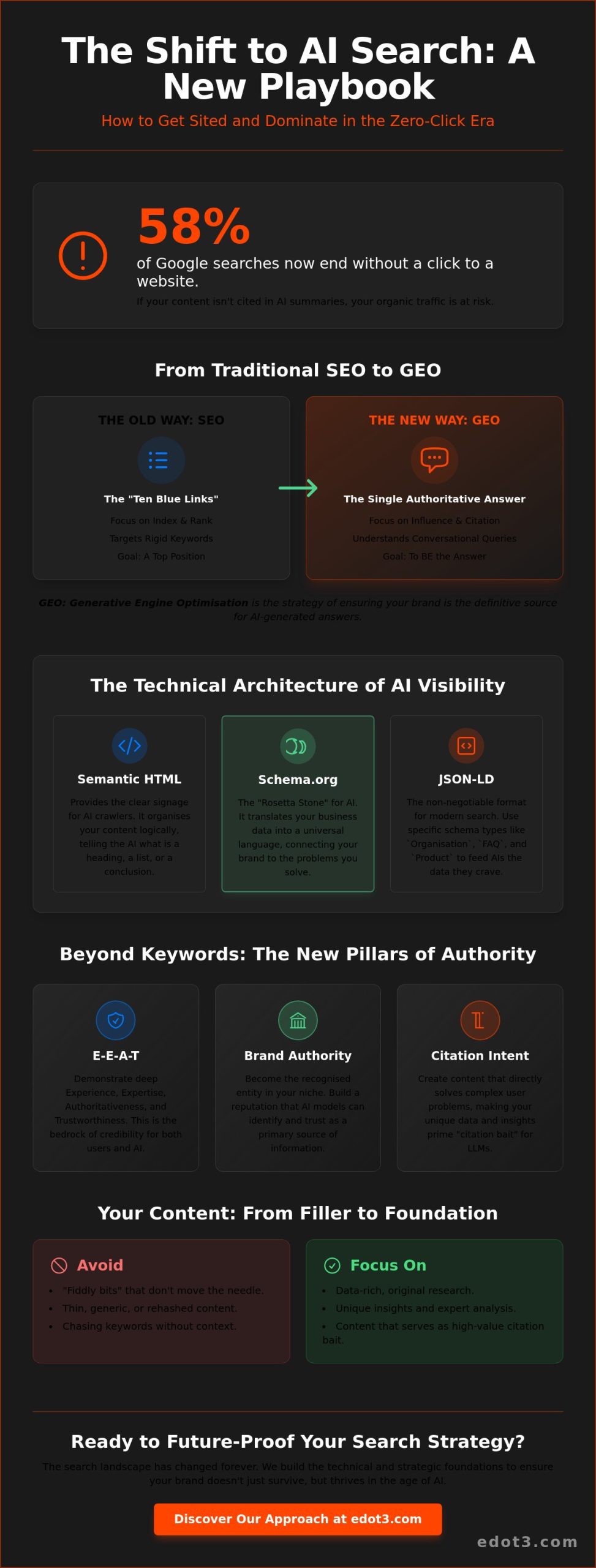
Did you know that 58% of Google searches now end without a single click to a website? It’s a staggering figure that confirms the traditional search landscape is being dismantled. If you’re feeling the sting of declining click-through rates and worrying about your content being cannibalised by AI summaries, you aren’t alone. The fear is real, but the solution isn’t to retreat; it’s to evolve. I’ve been in this game since 2007, and I know that Getting Sited in AI Search is the only way to stay relevant as AI Overviews and intelligent search boxes take over the SERP.
This isn’t an optional extra; it’s the new foundation of digital authority. You need to find, convince, and convert users even when they never land on your homepage. I promise to provide you with a clear, technical roadmap to ensure your brand is the one being cited and recommended by leading AI engines. We’ll explore how to transition from traditional SEO to a robust generative strategy that protects your ROI and keeps your brand at the centre of the conversation.
Key Takeaways
- Understand the fundamental shift from ranking in traditional blue links to becoming the definitive answer through Generative Engine Optimisation (GEO).
- Master the technical foundations, such as Schema.org and semantic HTML, that allow AI crawlers to accurately parse and prioritise your content.
- Discover the strategic framework for Getting Sited in AI Search by building high-level brand authority and deep-rooted E-E-A-T.
- Learn how to audit your content to replace “fiddly bits” with data-rich, original research that serves as high-value citation bait for LLMs.
- Establish a future-proof roadmap that maintains your brand visibility and influence in an increasingly zero-click search environment.
From Traditional SEO to GEO: Why AI Search Changes Everything
The era of the ‘Ten Blue Links’ is effectively dead. For nearly two decades, we’ve played a game of index-and-rank, fighting for the top spot on a page of search results. Today, that page is being replaced by a single, conversational response generated by Large Language Models (LLMs). This fundamental shift has birthed Generative Engine Optimization (GEO). This isn’t just a fancy new acronym; it’s the strategic process of influencing LLM outputs to ensure your brand is the definitive answer, not just a suggested link.
Major players like SearchGPT, Perplexity, Google Gemini, and Claude are rewriting the rules of engagement. With zero-click searches hitting 58% in June 2026, the stakes couldn’t be higher. If your content isn’t being pulled into these AI summaries, your organic traffic will vanish. Getting Sited in AI Search is no longer a luxury for early adopters; it’s the only way to survive the ‘Single Authoritative Answer’ era.
To better understand the practical side of this shift, watch this helpful video:
The Mechanics of Retrieval-Augmented Generation (RAG)
LLMs don’t just rely on static training data anymore. They use a process called Retrieval-Augmented Generation (RAG) to pull real-time, dynamic information from the live web. Your traditional SEO foundations, like site speed and clean code, still provide the exceptional foundations required for crawlers to access your site. However, those foundations now need a generative upgrade to assist with Getting Sited in AI Search. RAG ensures that when a user asks a question, the AI retrieves the most relevant, up-to-date data. If your content is structured correctly, you become the primary source for that dynamic retrieval whilst your competitors are left in the digital dust.
Understanding User Intent in the AI Era
Conversational queries have replaced rigid keyword strings. Users no longer type ‘best SEO agency London’; they ask, ‘Who is the most experienced strategist for AI search in the UK?’ This marks a shift from simple information retrieval to complex problem-solving. You must align your content with this new behaviour to remain relevant. We’ve moved beyond ranking for terms to ranking for trust. Citation Intent is the bridge between a user’s complex query and the AI’s selection of your specific expertise as the most reliable solution. Mastering this intent is the secret to AI-PR SEO and long-term search dominance.
The Technical Architecture of AI Visibility
Getting Sited in AI Search requires more than just high-quality copy; it demands a robust technical skeleton. If your site code is a mess, an LLM won’t waste its processing power trying to decode it. Think of Semantic HTML as the clear signage in a massive library. It tells the AI exactly what constitutes a header, what is a list, and what represents the primary conclusion. Without this structure, your content is just digital noise. We focus on these exceptional foundations to ensure your brand is accessible to machine learning models.
Schema.org is the true Rosetta Stone for AI crawlers. It translates your business data into a universal language that machines understand instantly. Whilst some agencies obsess over fiddly bits that don’t move the needle, we prioritise deep structured data. By explicitly defining your entities, you help AI search engines connect the dots between your brand and the specific problems you solve. This clarity is what drives fragment discovery, allowing an AI to pick out a single, perfect sentence from your site to quote as the definitive answer.
Structured Data for Generative Engines
Implementing JSON-LD is non-negotiable for modern search. You must use specific Schema types like Product, FAQ, and Organisation to feed the AI precisely the data it craves. Don’t just list your services; define the relationships between them. For instance, ‘Speakable’ markup is now essential for voice-based AI search, ensuring your brand is the one read aloud by smart assistants. As the new rules for keyword optimization suggest, the focus has shifted from simple phrases to structured entity relationships that prove your authority.
Content Formatting for LLM Consumption
AI search engines are hungry for clarity. They prefer the ‘inverted pyramid’ style of information: give the direct answer in the first sentence, then provide the supporting detail. This structure makes Getting Sited in AI Search significantly more likely because it reduces the cognitive load on the LLM. You should also consider the following formatting rules:
- Use bulleted lists for process-heavy content.
- Use tables for data comparisons and specifications.
- Format H2s and H3s as direct questions to match conversational queries.
These are the favourite snacks of AI search engines. If you structure an H2 as ‘How do I get cited in AI search?’, you’re handing the answer to the model on a silver platter. Site speed and a healthy crawl budget also play a role; if your site is slow, AI crawlers will limit their indexing, leaving your best insights undiscovered. If you are concerned about your technical performance, you can get a digital health check to identify any blockers in your current setup.
Brand Authority and the Rise of AI-PR SEO
AI search engines don’t care about your vanity metrics. They don’t care about how many low-quality blogs link to your site or how much fluff you’ve published to hit a word count. In the generative age, Large Language Models (LLMs) prioritise trusted sources over high-traffic sites. They are looking for E-E-A-T: Experience, Expertise, Authoritativeness, and Trustworthiness. This shift means that Getting Sited in AI Search is now a game of verification. If Google Gemini or Perplexity sees your brand being discussed in high-authority UK publications, you gain immediate social proof that an algorithm can quantify. It’s not about being the loudest in the room; it’s about being the most verified.
External mentions act as the ultimate signal for AI systems. When a reputable industry journal or a national news outlet references your expertise, it validates your content in the eyes of the AI. This synergy between digital PR and search is the only way to maintain brand authority in a zero-click environment. You need to stop chasing clicks and start chasing citations. It is a fundamental change in how we measure success, moving from raw traffic to the frequency and quality of AI recommendations.
Building a Moat with AI-PR SEO
Traditional link building is often a race to the bottom. To truly influence an LLM’s knowledge graph, you need mentions that carry genuine weight. This is where AI-PR SEO becomes your most powerful weapon. This methodology isn’t about spamming the web; it’s about securing placements in industry-leading journals to prove your authority. A single mention in a top-tier publication is worth more than 100 low-quality backlinks. These high-level citations tell the AI that your brand is a reliable entity, making it far more likely to quote you as the definitive answer to a user’s problem. You are building a digital moat that competitors can’t easily cross.
The Entity-Based Search Strategy
Building a Content Strategy for Generative Citations
Most websites are cluttered with what I call ‘fiddly bits’—generic blog posts and thin service pages that offer no unique value to a Large Language Model. To succeed, you must audit your existing library and distinguish between filler and cite-worthy assets. AI search engines are hungry for original research, proprietary data, and unique insights. These data-rich assets act as the ultimate bait for Getting Sited in AI Search because they provide information the model cannot find anywhere else. If you’re simply rehashing what’s already on Wikipedia, don’t expect a citation.
An FAQ-first approach is essential for capturing the long-tail conversational traffic that now dominates the SERP. You need to maintain your brand’s unique voice whilst remaining clear enough for an algorithm to summarise without losing the context. It’s a delicate balance between being ‘summarisable’ for the machine and ‘loveable’ for the human reader. I’ve been refining these strategies since 2007, and the core truth remains: clarity wins. You can book a discovery session to see how your current content stacks up against these new generative requirements.
The 5-Step GEO Content Workflow
Influencing LLM outputs requires a repeatable, disciplined process. We use a specific Generative Engine Optimisation workflow to ensure every piece of content serves a strategic purpose:
- Step 1: Identify the ‘Core Questions’ your audience is actually asking AI assistants.
- Step 2: Create high-authority answers using an ‘Answer-Detail-Proof’ structure.
- Step 3: Optimise for semantic clarity and high entity density to help the AI map your expertise.
- Step 4: Distribute content through high-authority PR channels to build the necessary verification signals.
- Step 5: Monitor your AI citations and refine your technical structure based on which fragments are being quoted.
Combating AI Cannibalisation
The biggest threat to your ROI is an AI summary that provides the answer but gives the user no reason to visit your site. To combat this, you must build ‘Curiosity Gaps’ into your content. If the AI provides the ‘what’, your website must be the only place to find the ‘how’ or the ‘why’. You want the citation to act as a teaser that compels the user to click through for the full, data-driven experience. The landscape is shifting rapidly, and as we discussed in our analysis of the Google Antitrust Fallout, the volatility of search rankings means you cannot rely on old habits. Getting Sited in AI Search is your insurance policy against a world where the search box does the talking for you.
The EDOT3 Approach: Future-Proofing Your Search Dominance
At EDOT3, we don’t just chase trends; we build exceptional foundations. Our core philosophy—Find, Convince & Convert—is the bedrock of everything we do, and it has never been more relevant than in the generative age. Getting Sited in AI Search is the modern evolution of the ‘Find’ stage. However, a citation is merely a vanity metric if it doesn’t lead to a measurable return on your investment. Navigating the algorithmic complexity of today’s search environment requires more than just a transient employee ticking boxes. It demands Director-level strategy and the kind of accountability you only get from partners who have been in the game since 2007.
We combine technical SEO, high-end web design, and AI-PR SEO to ensure your brand isn’t just visible, but dominant. We strip away the fiddly bits that distract from real growth and focus on the technical frameworks that AI crawlers actually respect. This holistic approach ensures your digital presence is robust enough to handle whatever the next core update throws your way. You aren’t just hiring an agency; you’re securing a senior partner dedicated to your long-term ROI.
Beyond the Rankings: Conversion-Centric GEO
Getting cited is only half the battle. Once an AI search engine recommends your brand, your digital presence must work twice as hard to close the deal. Our High-Conversion Web Design ensures that the users who do click through from an AI summary find a seamless, persuasive experience. We bridge the gap between machine-readable data and human-centric persuasion. In a world of sterile, AI-generated noise, ‘Believable, Loveable Branding’ is your greatest competitive advantage. You need to look like the authority the AI claims you are. This emotional psychology is the difference between a momentary click and a lifelong customer.
Your Digital Road Map for 2026
The shift to AI search is happening now. As of June 2026, Google’s AI Mode has already surpassed one billion monthly users, and AI Overviews appear in 55% of all searches. Waiting for industry standards to settle is a recipe for failure. You need an aggressive, assertive approach to search marketing that protects your brand from being cannibalised by zero-click summaries. Getting Sited in AI Search is about being the first choice, the best choice, and the only choice the algorithm feels safe recommending.
We help businesses across the North East and London dominate their markets by staying ahead of the curve. If you’re ready to stop guessing and start growing, it’s time for a Digital Health Check. Let’s look at your AI readiness and build a road map that leaves your competition behind. Don’t settle for mediocre marketing when you can have exceptional foundations. Get in touch today and let’s get your brand the authority it deserves.
Master the Future of Search
The landscape has shifted, but the goal remains the same: find, convince, and convert. The transition from traditional SEO to GEO requires a radical rethink of your digital foundations. You’ve seen how technical clarity, entity-based authority, and data-rich assets are the essential keys to Getting Sited in AI Search. It’s time to stop chasing outdated metrics and start building the brand authority that Large Language Models actually respect. The era of the single authoritative answer is here, and your brand needs to be that answer.
Since 2007, I’ve led EDOT3 with a focus on results rather than distractions. We specialise in the intersection of AI-PR SEO and high-conversion design, ensuring your brand isn’t just mentioned, but leads the conversation. You deserve accountability and seniority, which is why we guarantee Director-level contact for every partner. The generative era is full of opportunity for those bold enough to move beyond the “fiddly bits” and invest in exceptional foundations. Let’s turn the threat of zero-click search into your greatest competitive advantage.
Stop letting AI summaries cannibalise your hard-earned traffic. Book your Digital Health Check and dominate AI search with EDOT3. Let’s secure your search dominance together.
Frequently Asked Questions
How do I know if my website is being cited by AI search engines?
You can track your performance through the dedicated AI impression data in Google Search Console, which began rolling out on 3 June 2026. This feature allows you to see exactly how often your content appears in AI Overviews. Beyond this, you should manually test conversational prompts in tools like Gemini and Perplexity to verify if your brand is being recommended as a primary source.
Will AI search eventually replace traditional Google SEO entirely?
No, but it has fundamentally changed the objective of search marketing. Traditional SEO still provides the technical foundation that allows bots to crawl your site, but the focus has shifted from winning a click to becoming the cited authority. You must balance the two strategies to maintain visibility. Traditional blue links still exist, but they’re increasingly secondary to the single authoritative answer provided by AI.
What is the difference between SEO and GEO?
SEO focuses on ranking your website in a list of links based on keyword relevance. Generative Engine Optimisation (GEO) is the strategic process of influencing LLM outputs to ensure your brand is cited within the AI’s generated response. Whilst SEO is about being found, GEO is about being trusted and referenced as the definitive solution to a user’s problem. It is a shift from retrieval to recommendation.
Can I block AI crawlers whilst still ranking in search?
It is a risky move that could damage your long-term visibility. As of June 2026, Google is testing an opt-out toggle with a subset of UK site owners, but choosing to hide from AI crawlers often means you’ll be excluded from AI Overviews entirely. In a world where 55% of searches trigger an AI summary, blocking these crawlers is essentially opting out of more than half of your potential traffic.
How much does it cost to optimise for AI search in 2026?
The cost depends entirely on your current technical health and the competitive nature of your industry. It isn’t a one-off fee but a strategic investment in your digital foundations and PR-SEO. You should consider the subscription costs of professional tools like SEMrush or Ahrefs as a baseline for your internal team. For a precise understanding of the required investment, a professional audit is the only reliable starting point.
Does my website need to be on WordPress to rank in AI search?
Your choice of CMS doesn’t matter as much as the code it produces. AI search engines care about semantic HTML and Schema.org markup, not whether you use WordPress, Shopify, or a custom build. If your platform allows you to organise information clearly and implement deep structured data, you can succeed. We focus on exceptional foundations rather than the specific software, ensuring the AI can parse your content without friction.
What are the best tools for tracking AI search citations?
Google Search Console is currently the most accurate source for AI impression data. Professional platforms like SEMrush and Ahrefs have also updated their suites as of 2026 to include generative visibility tracking. These tools help you monitor your brand’s footprint across the LLM landscape. For a deeper look at your performance, you can use these insights to refine your strategy for Getting Sited in AI Search and stay ahead of competitors.
Is structured data more important for AI than for traditional SEO?
Yes, it is the most critical technical factor for Getting Sited in AI Search. Structured data acts as a Rosetta Stone for AI crawlers, allowing them to understand the relationships between entities on your site instantly. Whilst traditional SEO used Schema to enhance snippets, AI search uses it to build its entire knowledge graph. Without it, you’re making the AI work too hard to find the answers it needs to cite you.