


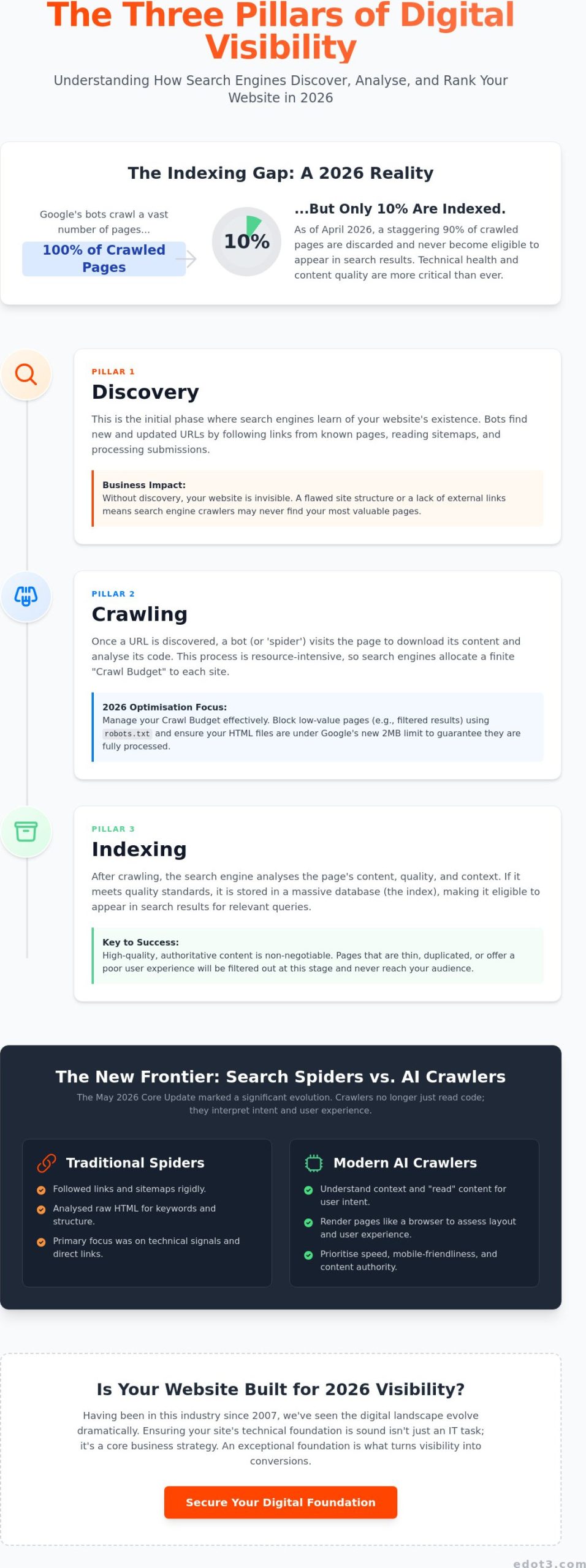
Did you know that as of April 2026, Google only indexes about 10% of the pages its bots actually crawl? If you are sitting in board meetings wondering why your latest digital investment isn’t moving the needle, it is time to strip away the technical jargon and understand exactly what a crawler means for your business visibility. It is not just a bit of background code; it is the high-speed bridge between your brand’s content and your customer’s discovery. Without a clear path for these spiders, your website is effectively invisible.
It is incredibly frustrating to realise that hidden technical issues are throttling your growth whilst your competitors seem to dominate the SERPs. I am going to help you master the technical foundations of how search engines discover your business so you can optimise for maximum impact. We will explore the critical 2026 shifts, from Googlebot’s new 2MB limit for HTML files to the fallout of the May 2026 Core Update, giving you the knowledge to hold any agency accountable and ensure your site is built on an exceptional foundation that actually converts.
Key Takeaways
- Demystify the technical jargon by understanding exactly what a crawler means for your business visibility and why these spiders are the lifeblood of your digital presence.
- Discover the systematic process of the “Three Pillars”—Discovery, Crawling, and Indexing—to ensure your site’s architecture supports rather than hinders growth.
- Learn why managing your “Crawl Budget” is essential for directing search engine attention away from low-value pages and towards your most profitable content.
- Prepare for the 2026 shift by understanding how AI model crawlers differ from traditional search spiders and how they now “read” for user intent.
- Gain the professional authority to hold your technical teams accountable by identifying the specific bottlenecks that prevent your brand from being found and converted.
What “Crawler” Means: Beyond the Dictionary Definition
If you look at a standard dictionary, it might tell you a crawler is a baby on all fours or a slow-moving vehicle. In the high-stakes world of digital growth, understanding what a crawler means is much more significant. A crawler is a sophisticated, automated software programme designed to systematically browse the World Wide Web, acting as the frontline scout for search engines. With Google’s index now containing over 130 trillion pages as of April 2026, these bots are the only way search engines can keep up with the sheer volume of data produced every second.
The industry often uses the term “spider” because these bots navigate the “web” by following links. Every link on your site is a thread; if a thread is broken or leads to a dead end, the spider stops. This process is “crawling”, which is the act of discovery, and it is fundamentally different from “indexing”, which is the process of storing that information. You can find a comprehensive overview of web crawlers that details their history, but for a director, the takeaway is simple. This is the absolute foundation of the “Find” stage in your marketing. If the bots don’t find you, your business effectively does not exist online.
To better understand the distinction between different types of bot activity, watch this helpful video:
The Business Context: Your Digital Gatekeeper
These bots are your digital gatekeepers. They are the first “visitors” to your site, and their report determines whether a human ever follows. Since I started in this industry in 2007, we have seen these bots evolve from simple text-readers into complex algorithms that mimic human behaviour. They don’t just look for keywords anymore. In 2026, they assess load speeds, mobile responsiveness, and layout stability. A crawler’s perception of your technical health dictates your market authority. If the bot finds “fiddly bits” like broken scripts or bloated code, it won’t just ignore that page; it may de-prioritise your entire domain, leaving you invisible to your target audience.
Common Jargon: Spiders, Bots, and Harvesters
You will hear plenty of names thrown around in UK boardrooms: spiders, bots, robots, or even harvesters. Whilst they are often used interchangeably, there are nuances that matter for your ROI. “Good” bots, like Googlebot or Bingbot, follow the rules you set and help you get found. “Bad” bots or “harvesters” often ignore your instructions to scrape your data or find security vulnerabilities. Recognising these terms isn’t about winning a technical debate. It is about having the language to hold your technical teams or agencies to account. You need to know if your site is being ignored by the major search players or hammered by malicious scrapers. Clear communication on what a crawler means for your specific site performance is the first step toward building an exceptional digital foundation.
The Three Pillars of Crawler Behaviour: Discovery, Crawling, and Indexing
To truly grasp what a crawler means for your bottom line, you must look past the surface and understand the three-step cycle that dictates your digital existence: Discovery, Crawling, and Indexing. With Google processing approximately 8.5 billion queries per day as of April 2026, the competition for attention is fierce. Search engines use a systematic process to map the internet, but they don’t have infinite resources. If your site doesn’t respect these three pillars, it won’t just rank poorly; it might not be found at all. For a more technical explanation of how web crawlers work, infrastructure leaders like Cloudflare provide deep dives into the bot-loop, but for business leaders, the focus is simple: no index, no sales.
Failure in any one of these pillars results in zero visibility. You can have the most beautiful brand in the UK, but if the discovery phase fails, you are invisible. If your code is too heavy for the crawling phase, you are ignored. If your content lacks authority for the indexing phase, you are forgotten. It is a brutal, automated filter that cares only about efficiency and relevance. As of April 2026, only about 10% of pages crawled by Google actually make it into the index. To be part of that elite 10%, your technical foundations must be exceptional.
Discovery and the Importance of Sitemaps
Discovery is the scout phase. Bots identify new or updated URLs through sitemaps or by following links from other pages. If you want a crawler to know your new content exists immediately, you cannot leave it to chance. A clean URL structure and a regularly updated XML sitemap are non-negotiable. Think of internal linking as the map for the crawler; if your high-value pages are buried five clicks deep, the bot might never reach them. You need to lead the spider directly to the content that converts.
Crawling and Rendering: Making Sense of the Code
Crawling is the retrieval phase where the bot requests the page and reads the code. In early 2026, Google updated its protocol to only read the first 2MB of uncompressed HTML content. If your page is bloated with “fiddly bits” or unoptimised scripts, the bot stops before it even sees your primary offer. Modern crawlers also have to render JavaScript, which is resource-intensive. If your site isn’t mobile-responsive or takes too long to load, the crawler will deprioritise you to save its own “crawl budget”. Speed isn’t just a user experience factor; it is a fundamental requirement for being crawled effectively. If you suspect your technical foundations are blocking these pillars, it might be time to discuss a digital health check with a director who understands the stakes.
Why Crawler Access is the Lifeblood of Your Digital Visibility
Technical SEO is often dismissed as a collection of “fiddly bits” that can wait until the next site refresh. This is a dangerous mistake for any director focused on ROI. Let’s be blunt: if you don’t have an index, you don’t have sales. Understanding what a crawler means for your revenue starts with recognising that search engines operate on a strict, finite schedule. They do not have infinite time to spend on your website. This is your “Crawl Budget”. If a spider spends its limited allocation on broken links or low-value pages, it might leave your site before it ever discovers your most profitable content.
Efficiency is everything. When a crawler visits your site frequently, it is a clear signal of your brand’s perceived authority. Frequent visits mean your new products, price changes, or thought-leadership pieces are reflected in search results within hours. If your architecture is sluggish, that frequency drops. You end up in a cycle where your best content sits invisible for weeks whilst your competitors, who have prioritised their technical foundations, steal the march on every new trend. High-performance visibility isn’t a happy accident; it is the result of intentional, crawler-friendly design.
Maximising Your Crawl Budget
Search engines are ruthless with their time. To protect your visibility, you must identify and prune “low-value” pages that distract bots from your high-conversion content. This includes duplicate pages, old tag archives, or internal search result pages that offer zero value to a customer. As detailed in Google’s official documentation on Googlebot, you can use a robots.txt file to act as a traffic director. By explicitly telling bots which areas of your site are off-limits, you ensure they spend every second of their budget on the pages that actually drive growth. Don’t let your best pages stay hidden behind a wall of technical debt.
The ROI of Crawler-Friendly Architecture
A high-performance site structure does more than just please a bot; it reduces the time between “publish” and “profit”. When your technical search engine optimisation is handled correctly, you create a streamlined path for discovery. This is the “Find” stage of the digital roadmap. By ensuring your site is built on exceptional foundations, you allow crawlers to render your content accurately and swiftly. This approach is central to the philosophy of The Strategic Digital Agency, where the goal is to find, convince, and convert through believable branding and technical excellence. A site that is easy to crawl is a site that is easy to sell.
The New Frontier: Search Engine Spiders vs AI Model Crawlers
The digital landscape in 2026 is unrecognisable from the world I entered in 2007. We are no longer just managing a relationship with Googlebot; we are navigating a crowded ecosystem of aggressive AI agents. By April 2026, dedicated AI training crawlers accounted for 51.5% of all AI bot traffic. This massive shift has forced a total re-evaluation of what a crawler means for your brand’s digital safety. Whilst traditional search spiders index your site to rank it, AI crawlers harvest your intellectual property to train models or provide synthesized, natural-language answers. The game has changed. You aren’t just being found; you are being consumed.
Search engines now add a fifth layer to their process: synthesis. Google’s AI Mode and Bing Copilot use data from these bots to generate answers that can bypass your website entirely. Understanding what a crawler means in this context requires a strategy that balances visibility with protection. You must decide whether to feed these models to stay relevant or block them to protect your unique value. With Googlebot’s share of AI crawler traffic dropping to 29.96% and Applebot holding 9.1%, the monopoly is over. Your technical foundations must now speak to a diverse range of bots that read for intent rather than just keywords.
AI Search Optimisation (ASO) and Bot Perception
To win in 2026, you must categorise your brand as an authority in the eyes of these new agents. AI Search Optimisation relies heavily on structured data and Schema. This isn’t just about “fiddly bits” of code; it is about providing a clear, machine-readable map of your expertise. If an AI crawler cannot instantly verify your authority, it will hallucinate or cite a competitor. Managing this complex interaction requires specialist oversight, often involving EDOT3’s AI-SEO services to ensure your content is being processed accurately by both traditional spiders and modern LLM bots.
To Block or Not to Block?
This is the definitive strategic debate of 2026. Blocking bots like GPTBot or Claude-SearchBot (which held 7.6% of AI bot traffic in April) protects your content from being scraped without credit. However, it also ensures you will never be cited by the AI assistants your customers are using. The emergence of PR-SEO has become a vital tool here, allowing brands to influence the data sets these crawlers use without giving away the crown jewels. If you are unsure whether your current robots.txt is protecting your assets or sabotaging your future visibility, book a consultation with a director today to audit your bot permissions.
Optimising for the Bots: Technical Foundations for Business Growth
Moving from the theoretical to the practical is where most businesses stumble. Understanding what a crawler means is only the first step; taking assertive action to clear their path is what actually drives ROI. Too often, senior leadership prioritises superficial aesthetics or the “wow factor” of a site whilst ignoring the structural rot that prevents search engine spiders from doing their job. If your foundations are weak, no amount of pretty branding will save your visibility. You must stop treating technical SEO as a secondary concern and start seeing it as the primary engine of the “Find” stage in your digital roadmap.
Grasping what a crawler means for your bottom line requires a shift in perspective. You aren’t just building a site for humans; you are building a data structure for the most sophisticated machines ever created. A “Digital Health Check” is no longer optional. It is a strategic necessity to identify the bottlenecks that are currently throttling your growth. By focusing on exceptional foundations, you ensure that every page you publish has a fighting chance of being discovered, rendered, and indexed by the bots that matter most.
The 2026 Technical Audit Checklist
To maintain crawler health in the current landscape, your audit must go deeper than surface-level checks. First, review your server response times. In 2026, a response time of under 200ms is the benchmark for maintaining a healthy crawl frequency. Modern bots use “headless” browsers to render your site exactly as a user would, so you must ensure that your branding and primary content aren’t hidden behind complex, slow-loading scripts. Finally, you need a partner who understands “Algorithmic Complexity”—the ability to predict how changes in search engine behaviour will impact your site architecture before they happen.
Partnering for Performance with EDOT3
Since 2007, we have been in the game, building high-conversion websites that bots love and humans trust. We don’t believe in “fiddly bits” or transient employees who disappear when things get difficult. Our commitment to Director-level contact ensures that your strategy is always handled by a seasoned expert, never a junior. Whether you require Technical Search Engine Optimisation to fix legacy issues or AI Search Optimisation to prepare for the future of search, our focus remains on your ROI. Stop letting your competition dominate the discovery phase and take control of your digital authority. To get started, contact our strategists today and let’s build an exceptional foundation together.
Secure Your Digital Authority and Dominate the SERPs
The 2026 search landscape is brutal but full of opportunity for directors who act decisively. You now understand that what a crawler means for your bottom line is the difference between market dominance and total digital invisibility. By prioritising technical authority and streamlining your site architecture for both Googlebot and aggressive AI agents, you secure a future where your brand is always the first answer provided. It is about moving beyond superficial aesthetics to build something that actually works for your ROI.
Since 2007, we have helped businesses navigate these algorithmic complexities with a focus on results rather than distractions. We provide Director-level involvement on every project, bringing deep specialism in High-Conversion Web Design and AI Search Optimisation to the table. We don’t hide behind technical jargon or “fiddly bits”; we deliver the exceptional foundations your business needs to thrive in a competitive market. Don’t let technical debt or poor crawlability hold your growth back for another quarter.
Get your Digital Health Check and optimise for success.
Your business deserves to be seen and trusted by both bots and humans alike. Let’s make it happen together.
Frequently Asked Questions
Does “crawler” mean the same thing as a “bot” or “spider”?
Yes, these terms are essentially synonymous in the SEO world. A crawler is the technical term for the software, whilst spider is the common metaphor and bot is the broader category. Understanding what a crawler means for your site involves recognising that these are just different labels for the same automated discovery agents. They all perform the same foundational task: finding, reading, and storing your data to help customers find your brand.
How can I tell if a crawler is currently visiting my website?
You can monitor crawler activity through your server logs or via Google Search Console’s Crawl Stats report. These logs show every request made by bots like Googlebot or Bingbot. If you see a spike in activity from specific IP addresses associated with search engines, you know your site is being actively indexed. This is the most reliable way to verify bot behaviour and ensure your technical foundations are being correctly processed.
Can a crawler negatively affect my website’s loading speed?
Yes, aggressive crawling can consume significant bandwidth and CPU resources if your server isn’t configured correctly. Major search engines usually slow down if they detect your server is struggling. However, poorly coded bad bots or scrapers can hit your site hundreds of times a second. This causes noticeable lag for your human visitors. It’s why we prioritise exceptional server response times as part of any technical search engine optimisation project.
What happens if I block all crawlers in my robots.txt file?
Your website will vanish from search results almost entirely. By blocking all bots, you tell search engines to stop visiting and indexing your pages. Whilst the pages exist on your server, they won’t be updated in the search index. New content will never be found. It is a catastrophic move for any business. Never use a blanket block unless you are working on a private, non-public staging site.
How often do search engine crawlers visit a typical UK business site?
Frequency depends entirely on your site’s authority and how often you update your content. High-authority news sites might be crawled every few minutes. A typical UK SME site might see a visit every few days or weeks. If your technical foundations are solid and you publish fresh content regularly, you will encourage more frequent visits. Bots prioritise sites that provide consistent value and load quickly without technical bottlenecks.
Why is my new page not appearing in search results even though I published it?
Discovery isn’t instantaneous. Even after a bot finds your URL, it must still crawl the code and decide if the page is worthy of indexing. In 2026, Google is more stringent about quality signals. If your page has thin content, technical errors, or lacks internal links, the crawler may deprioritise it. This leads to indexing delays. Ensure your sitemap is updated and your internal linking structure is clear to speed up this process.
What is the difference between web crawling and web scraping?
Crawling is about discovery and indexing for search, whilst scraping is about extracting specific data for other uses. Crawlers follow links to map the entire web’s structure. Scrapers are usually targeted at specific information, such as prices or contact details. Understanding what a crawler means in a strategic sense helps you distinguish between these helpful scouts and malicious data harvesters. One builds your visibility; the other often just steals your intellectual property.
Are AI crawlers like ChatGPT’s bot different from Google’s crawler?
Yes, their primary purpose is training rather than indexing. Googlebot’s goal is to place your site in a list of results. AI crawlers like GPTBot or Claude-SearchBot ingest your content to help the model generate its own answers. This distinction is vital for your strategy. AI bots don’t always provide the same direct referral traffic that search engines do. You must decide whether the citation reward outweighs the risk of content scraping.