

Google isn’t a search engine anymore; it’s an answer engine that prioritises its own AI-generated slop over the very websites it’s supposed to index. You’re likely fed up with AI Overviews hogging your screen and hallucinated facts masquerading as truth. It’s exhausting trying to find original, human-written content amongst a sea of LLM filler. This is why savvy professionals are now hunting for alternative search engines without ai to reclaim their research efficiency and find unfiltered data.
We’ll show you exactly how to strip away the synthetic noise and find the tools that still deliver raw web links. You’ll discover how to use DuckDuckGo’s new “No AI” browser extensions released in June 2026 and why Mojeek’s independent Gravity index is a game-changer for unfiltered discovery. We’re moving past the distractions of modern search to provide a clear roadmap for finding authentic information. It’s time to stop settling for AI-generated summaries and get back to the exceptional foundations of the open web.
Key Takeaways
- Understand the degradation of search quality and why generative AI is creating a feedback loop of low-value, recycled information.
- Identify the best alternative search engines without ai that prioritise traditional indexing and independent crawlers over synthetic summaries.
- Learn the technical difference between metasearch engines and independent indexes to avoid the risks of a search monoculture.
- Discover how to adapt your SEO strategy to prioritise authority and believable branding across a fragmented, post-Google landscape.
- Master the “Find, Convince, and Convert” methodology to ensure your business remains visible wherever your audience chooses to search.
Why the Internet is Revolting Against AI-Driven Search
Google’s decision in May 2026 to force AI-generated summaries onto every search result has triggered a mass exodus. Users aren’t just annoyed; they’re losing access to the primary sources that make the web useful. A Politico survey in 2026 found that 84% of Europeans do not trust American tech companies to handle their data responsibly, and this distrust now extends to the accuracy of AI-driven results. When an AI overview takes up the entire mobile screen, the “raw web” of actual websites gets buried beneath layers of synthetic noise. This degradation of quality is exactly why searchers are flocking to alternative search engines without ai to find the unfiltered truth. The internet is revolting because the fundamental promise of search, finding the best source, has been replaced by a mediocre guess.
To better understand how the search landscape is shifting, watch this breakdown of the current top contenders:
The “AI Slop” Problem: When LLMs Recite Each Other
We’re witnessing the birth of a digital feedback loop. Generative AI models are increasingly training on data produced by other AI models, leading to a phenomenon known as “model collapse.” This creates “AI slop”, recycled, low-quality content that lacks the depth of human expertise and unique insight. If you’re trying to build authority, being buried in this loop is a death sentence for information integrity. Human-curated content and verified data are now the most valuable assets online. For those needing a deeper dive into the technical landscape, checking a comparison of web search engines reveals which platforms still respect the integrity of a traditional web index without forced overlays.
Reclaiming the Raw Web for Professional Research
The Best Alternative Search Engines Without AI in 2026
The “blue link” is making a massive comeback amongst power users who value raw data over synthetic summaries. Finding alternative search engines without ai is no longer just a privacy preference; it’s a technical necessity for anyone who needs to verify facts at the source. We’ve vetted the current landscape based on three strict criteria: index independence, privacy protocols, and the ability to completely bypass generative overlays. Whether you prefer a paid subscription for a cleaner experience or a free, independent crawler, these tools allow you to reclaim your research efficiency without the interference of predictive algorithms.
Mojeek: The Champion of Independent Indexing
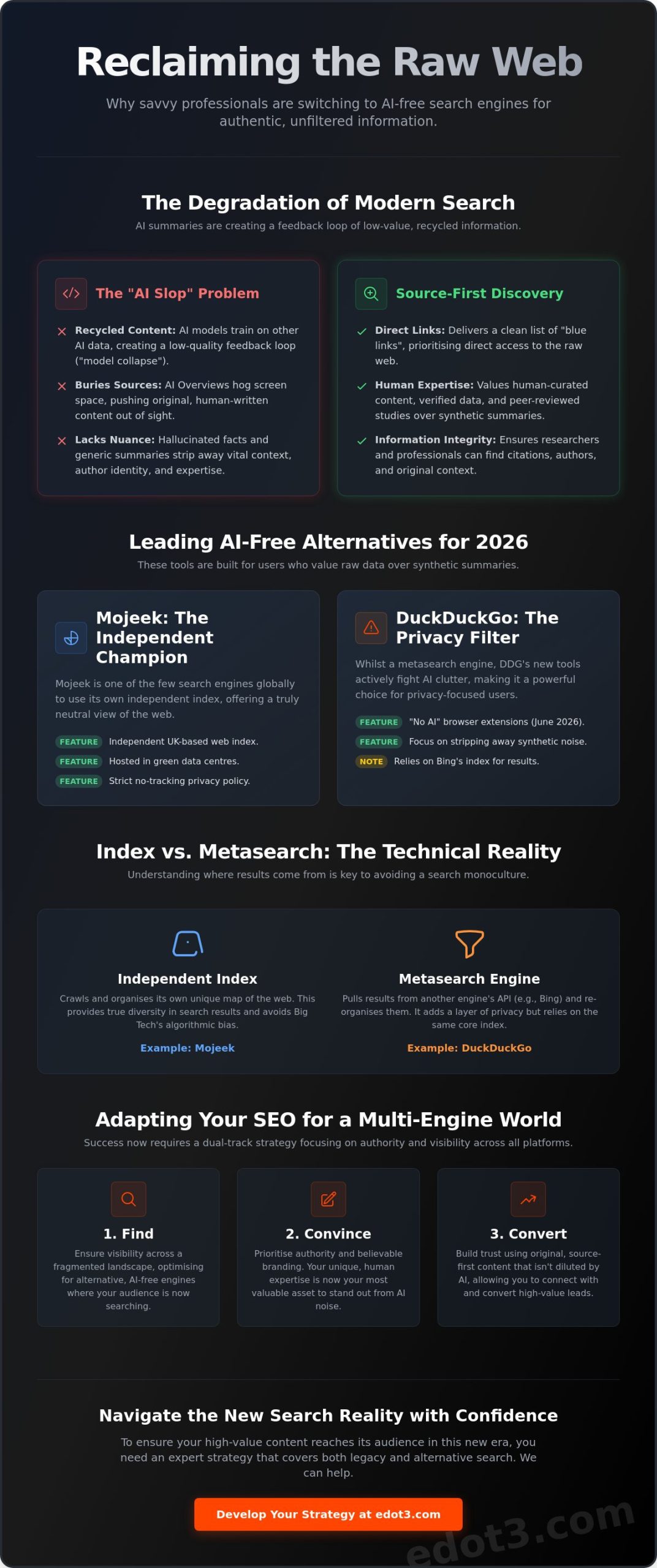
Mojeek stands alone as one of the few engines globally that maintains its own independent web index. Based in the UK and hosted in green data centres, it doesn’t rely on APIs from Google or Bing. This independence is vital because it avoids the algorithmic biases and AI-prioritisation inherent in Big Tech. When you search on Mojeek, you’re getting a truly neutral view of the web. It’s a no-tracking, no-bias environment that organises results based on traditional relevance rather than what an LLM predicts you want to hear. This is the gold standard for unfiltered discovery.
Kagi and Startpage: Privacy Without the AI Clutter
For those who want the quality of Google results without the tracking or AI Overviews, Startpage acts as a high-security proxy. However, the real disruptor in 2026 is Kagi Search. As a subscription-based model, Kagi offers plans ranging from approximately $5 to $25 per month, with a popular $10 tier that eliminates the need for advertising. This model is the ultimate shield against “ad-slop” and AI filler. Kagi’s “Lenses” feature is particularly powerful, allowing you to filter your results to show only human-written content or academic sources, effectively purging recycled filler from your view.
Qwant and Brave Search: The European and Privacy Alternatives
Qwant continues to lead the charge for European tech sovereignty, offering neutral results that respect strict data privacy laws. Meanwhile, Brave Search has become a favourite for developers and search professionals. Whilst Brave does offer an “Answer Engine,” it provides a clear, permanent toggle to disable it, returning you to a traditional, lightning-fast list of websites. Even DuckDuckGo has responded to the demand for alternative search engines without ai. Following their June 2026 browser extension release, users can now route all queries through an AI-free version of their search page, ensuring that traditional indexing remains the primary focus of the experience.
Independent Indexes vs. Metasearch: The Technical Reality
Most users believe switching search engines is merely a matter of changing a brand logo. It’s actually a choice about the underlying data source. If you’re hunting for alternative search engines without ai, you must understand the technical chasm between an independent index and a metasearch engine. One builds its own map of the digital world; the other simply borrows a map from someone else. Relying on a search monoculture where only two companies decide what’s “helpful” is a strategic risk for any professional researcher or business owner.
How a Search Crawler Means the Difference Between Discovery and Echo Chambers
A crawler is a sophisticated bot that discovers, reads, and categorises the web. Engines that build their own independent indexes do so by sending these bots out to find content rather than mirroring the results of the Big Two. This independence is the only way to escape the echo chambers created by aggressive “Helpful Content” filters, which often suppress smaller, high-authority sites in favour of massive corporate entities. For a website to remain visible, it requires exceptional foundations in technical SEO. You must ensure your site is accessible to these independent bots, allowing them to index your original insights without the bias of an AI-first algorithm.
The Metasearch Trap: When “Alternatives” Are Just Proxies
Metasearch engines are useful for privacy, but they are essentially proxies. They pull their results via APIs from primary providers. This creates a technical vulnerability. If the primary provider decides to force AI-generated slop into their API feed, the “alternative” proxy often inherits that same content automatically. This is why businesses must diversify their search presence. Relying solely on engines that wrap existing data means you’re still subject to the same algorithmic complexity. True discovery happens when you optimise for platforms that prioritise traditional ranking over generative guesses.
Strategic visibility in 2026 requires a deep understanding of the technical search engine optimisation needed to make a brand visible across this fragmented landscape. Success is no longer about chasing a single engine; it’s about ensuring a site has the authority to rank wherever users are looking. Understanding how these crawlers function is the first step in ensuring an audience can find and engage with a business without being distracted by synthetic filler or hallucinated summaries.
How AI-Free Search Changes Your SEO Strategy
Optimising for the “Human-Only” Web
Competitive Intelligence Without the Noise
AI-free engines are your secret weapon for cleaner competitive intelligence. Google’s “Brand Bias” often hides smaller competitors who are rocking it with superior content. By using an independent index like Mojeek, you can see who is actually ranking based on raw relevance rather than corporate weight. This allows you to identify genuine PR SEO opportunities by finding where your competitors are being mentioned in human-written articles, rather than recycled AI blogs. To truly understand where you stand, running a high-energy website seo checker audit is still your best friend for identifying the technical gaps that AI summaries tend to ignore.
Success in this new era requires a partner who understands the nuance of both generative search and traditional discovery. If you’re ready to stop guessing and start dominating the results, book a digital health check with an EDOT3 Director today. We’ll help you find, convince, and convert your audience across every engine that matters.
Find, Convince, and Convert in a Multi-Engine World with EDOT3
The rise of alternative search engines without ai means your digital presence must be more resilient than ever. You cannot afford to put all your eggs in one basket. We provide a dual-track strategy that masters AI search optimisation for the legacy giants whilst securing your authority in independent indexes. It’s about building a brand that transcends any single platform or algorithm. We focus on the exceptional foundations that make your business a definitive leader in your space, ensuring you leave the competition behind in the race for authentic discovery.
The EDOT3 Digital Health Check
Our Digital Health Check is the definitive entry point for businesses ready to cut through the noise. We perform a technical audit of your visibility across the entire search landscape, from Mojeek to Google. This process identifies critical gaps in your current web development agency strategy, ensuring your site isn’t just a pretty face but a high-conversion engine. We help you craft believable, loveable branding that resonates with humans, making your business the obvious choice amongst a sea of synthetic filler and recycled content.
Get Optimised for 2026 and Beyond
Stop chasing the latest algorithmic distractions and start building real authority. We leverage high-impact PR-SEO to ensure your brand earns the mentions and high-quality backlinks required to dominate niche and independent indexes. This isn’t about superficial aesthetics or “fiddly bits” that don’t drive ROI. It is about believable branding that establishes you as the expert in your field. The digital road map we build for you is designed for long-term stability and aggressive growth. If you’re ready to lead the pack and secure your place in the future of search, book your strategy session with EDOT3 today. We’re passionate partners who value real support over corporate jargon. Let’s get you rocking it.
Reclaim Your Search Authority in the Post-AI Era
The search landscape has fundamentally shifted, and relying on a single, AI-cluttered index is a risk your business can’t afford. By embracing alternative search engines without ai, you ensure your research remains accurate and your brand stays visible to high-value leads who demand raw, unfiltered data. We’ve explored how independent crawlers provide a vital escape from the “AI slop” feedback loop, whilst technical excellence remains the only way to bypass synthetic noise and reach your audience directly.
EDOT3 has been leading the way since 2007, providing nearly two decades of search expertise to clients who refuse to settle for mediocre results. We don’t do “fiddly bits” or pass your strategy off to junior staff. Every client works directly with a Director to implement our proven “Find, Convince, Convert” methodology. It’s time to stop settling for a fragmented presence and start dominating every engine that matters. Get a Digital Health Check and dominate the new search landscape. Your business deserves exceptional foundations. Let’s get to work.
Frequently Asked Questions
Is DuckDuckGo still an alternative search engine without AI?
DuckDuckGo is now considered AI-optional rather than entirely AI-free. Whilst they offer AI features like DuckAssist, they released dedicated browser extensions in June 2026 that allow users to default to an AI-free search page. This gives you the choice to strip away synthetic summaries. It is one of the most accessible alternative search engines without ai for those who want a familiar interface without the forced summaries.
Can I use alternative search engines on my mobile phone?
You can use these engines on any mobile device by changing your browser’s default search settings or downloading dedicated apps. Most modern browsers for iOS and Android now include options to select privacy-focused alternatives. This ensures your mobile browsing remains private and free from the AI-generated filler that often dominates mainstream mobile search results. It’s a simple way to reclaim your screen space on the go.
Do alternative search engines show fewer results than Google?
Mainstream engines often have larger indexes, but alternative engines prioritise result quality over sheer volume. Google’s index is massive, yet much of it is now cluttered with recycled AI content. Independent engines like Mojeek focus on crawling high-value, original sources. You might see a smaller number of total results, but the discovery of authentic, human-written content is often much higher than on the Big Two.
How do these engines make money if they do not track me?
These platforms typically rely on contextual advertising or direct user subscriptions. Contextual ads are based solely on your current search term rather than your personal history or behaviour. Other models, like Kagi, charge a monthly fee to provide a completely ad-free experience. This removes the incentive to track you or prioritise ad-heavy websites. It’s a transparent business model that puts the user first.
What is the best search engine for strictly human-written content?
Kagi Search is the premier choice for filtering out non-human content. Their Lenses feature is a game-changer for those seeking alternative search engines without ai, as it allows you to purge LLM-generated slop from your results. By specifically targeting blogs and forums, you can ensure the information you find was actually written by a person with real expertise. It’s the ultimate tool for professional research.
How can I submit my website to independent search engine indexes?
You can submit your URL directly to independent crawlers like Mojeek or Brave Bot through their respective submission pages. Unlike Google, which can take weeks to crawl new content, these independent engines are often very responsive to direct submissions. Ensuring your technical search engine optimisation is exceptional will help these bots categorise your pages accurately. This ensures you aren’t invisible to the growing number of privacy-conscious searchers.
Will using an alternative search engine improve my privacy?
Using an alternative engine significantly improves your privacy by ending the practice of search-based profiling. These engines don’t store your IP address or track your behaviour across different websites. This prevents tech giants from building a detailed dossier on your interests and habits. It’s a vital step for any professional who values data sovereignty and information integrity in an increasingly monitored digital world.
Is Kagi Search worth the monthly subscription fee?
Kagi is worth the investment for professionals who value research efficiency and data accuracy. With plans starting at approximately $5 per month as of June 2026, it provides a clean, ad-free interface that mainstream engines can’t match. If you’re tired of scrolling through AI Overviews and sponsored links, the time saved by getting straight to the websites you need justifies the cost. It’s a premium tool for premium results.