


Content marketing is defined as the creation and distribution of purposeful, audience-focused material that search engines rank and real people read, making it the foundation of every effective organic growth strategy. The role of content marketing in SEO is not supplementary. It is structural. Paid and organic search together generate 68% of all trackable website traffic. That figure alone tells you where your audience is looking and what you need to do to be found. By 2026, 90% of marketers integrate content into their marketing strategies, with 87% confirming increased brand awareness through expert content aligned with Google’s E-E-A-T guidelines. Platforms like BrightEdge confirm that content and SEO, treated as one engine rather than two separate departments, compound organic visibility over time.
How does content marketing support SEO performance?
Content marketing and SEO are mutually dependent disciplines. SEO without strong content has no ranking fuel. Content without SEO lacks a discovery mechanism. The two disciplines only perform at full capacity when they operate together.
SEO identifies the search queries your audience types into Google. Content marketing creates the material that answers those queries with sufficient depth, clarity, and authority. When keyword research directly guides content planning, you build progressive coverage across an entire topic cluster rather than chasing isolated rankings. A business that starts with a broad guide on “project management software” and then publishes supporting articles on “agile vs waterfall,” “how to choose a PM tool,” and “PM software for remote teams” expands its organic footprint with every piece. Each article reinforces the others through internal linking and shared topical authority.
The SEO benefits of content compound over time in ways that paid search cannot replicate. A well-structured article published today can attract backlinks, generate featured snippet appearances, and rank for hundreds of long-tail variants for years. Paid clicks stop the moment your budget does. Content marketing builds an asset.
- Keyword research drives content briefs. Start every piece of content with search data, not assumptions about what your audience wants.
- Topical authority beats single-page optimisation. Covering a subject comprehensively across multiple pages signals expertise to Google far more effectively than one long article.
- Backlink acquisition follows quality content. Journalists, bloggers, and industry sites link to original research, detailed guides, and comparison resources. They do not link to thin product pages.
- User engagement signals reinforce rankings. Time on page, scroll depth, and low bounce rates tell Google the content is genuinely useful.
Pro Tip: Map your keyword research to specific funnel stages before writing a single word. Informational queries belong at the top of the funnel; comparison and “best of” queries sit at the bottom. Matching content type to intent is the single fastest way to improve conversion rates from organic traffic.
What content marketing strategies best support SEO?
The most effective content marketing strategies for SEO share one characteristic: they are built around user intent, not internal business priorities. Content that aligns editorial narrative with technical SEO criteria creates sustainable competitive advantage in saturated markets.

High-quality, in-depth content that demonstrates genuine expertise performs best under Google’s E-E-A-T framework. A 2,000-word guide written by a practitioner with first-hand experience outranks a 500-word summary scraped from other sources, even if the shorter piece is technically optimised. Depth signals authority. Authority earns rankings.
Comparison guide content captures high-intent users at the bottom of the purchase funnel. A buyer searching “HubSpot vs Salesforce for small business” has already decided to buy. They need help choosing. A well-structured comparison guide that answers their specific question converts at a far higher rate than a generic product page. This is the content format that builds what SEO professionals call a “moat” around qualified traffic.
The most productive content formats for SEO include:
- Long-form guides and pillar pages. These establish topical authority and attract backlinks naturally.
- Comparison articles. These target bottom-funnel, high-intent searchers who are close to a purchase decision.
- Case studies. These demonstrate real-world results and build trust with both readers and search engines.
- Video content with transcripts. Video increases time on page. Transcripts give search engines text to index.
- FAQ sections. These target question-based queries and increase the chance of appearing in featured snippets.
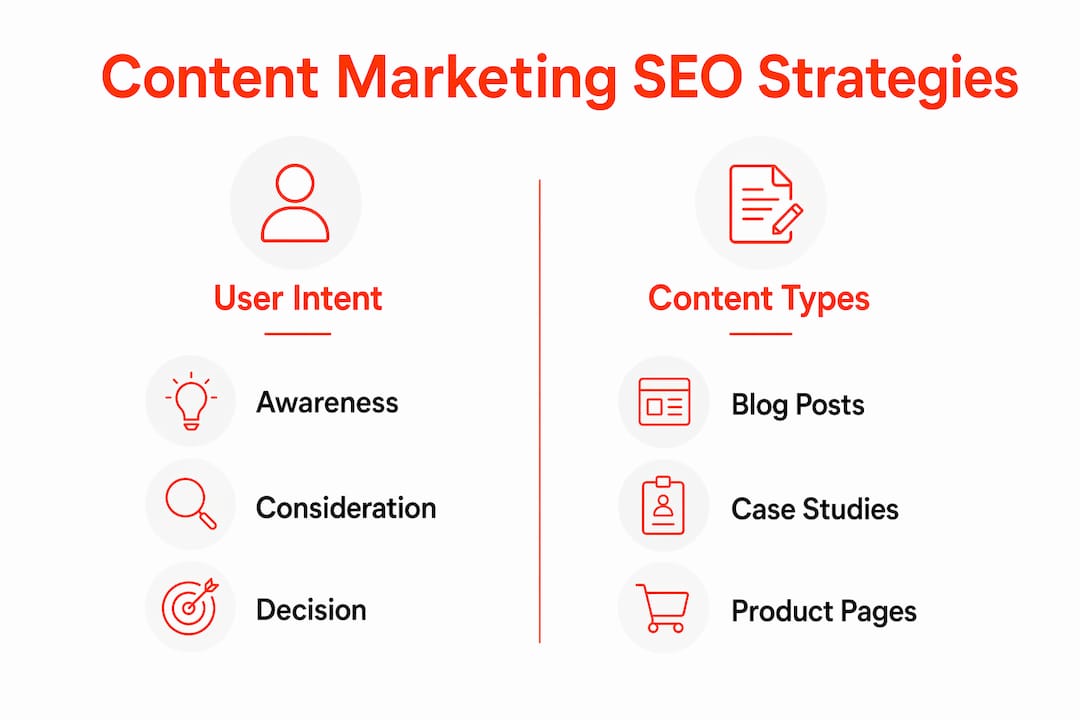
Aligning content with the full buyer journey means publishing material at every stage. Awareness content answers broad questions. Consideration content compares options. Decision content removes final objections. A content programme that covers all three stages creates multiple entry points from organic search.
Why do separate content and SEO teams underperform?
SEO and content marketing teams often optimise different objectives with different briefs, producing isolated efforts that consistently underperform compared to integrated approaches. This is one of the most common and costly mistakes in digital marketing.
A content team focused purely on brand storytelling may produce engaging articles that never rank because they ignore search volume, keyword placement, or internal linking. An SEO team focused purely on technical signals may produce keyword-stuffed pages that rank briefly but fail to engage readers or earn backlinks. Neither outcome serves the business.
The solution is structural alignment, not just goodwill between teams. Practical steps to integrate content and SEO workflows include:
- Shared content briefs. Every piece of content should begin with a brief that includes target keywords, search intent, competitor analysis, and engagement goals. Both teams contribute to and sign off on this document.
- Unified reporting dashboards. Tracking organic traffic, rankings, time on page, and conversion rate in one place forces both teams to own the same outcomes.
- Joint editorial calendars. Publishing schedules should reflect keyword opportunity windows, seasonal search trends, and product launch timelines simultaneously.
- Regular cross-team reviews. Monthly reviews where content and SEO teams share performance data identify what is working and what needs adjustment faster than siloed reporting.
- Shared keyword and topic libraries. A central repository of approved keywords, topic clusters, and content gaps prevents duplication and ensures every new piece of content fills a genuine search demand.
Pro Tip: Assign a single owner to the content-SEO brief for each campaign. When two teams share responsibility without a named lead, decisions stall and briefs get diluted. One person accountable to both teams produces faster, sharper output.
Tools like Semrush, Ahrefs, and Google Search Console provide the shared data layer that makes this collaboration possible. When both teams work from the same keyword and performance data, their objectives naturally converge.
How to structure content for SEO in 2026
Content structure is now as important as content quality. Structuring content with question-based H2 and H3 headings greatly increases the chance of search engines featuring content in AI-driven summaries and featured snippets. This matters because AI-powered search interfaces like Google’s AI Overviews extract answers directly from well-organised pages.
Why technical writing improves SEO comes down to one principle: machines parse structure before they evaluate meaning. A page with clear headings, short paragraphs, and explicit answers to user questions is far easier for a search algorithm to extract and surface than a page with dense, unbroken prose. Organising content according to user intent and problem-space rather than internal product architecture reduces bounce rates and improves rankings.
The table below compares two approaches to content structure and their SEO outcomes.
| Approach | Structure type | SEO outcome |
|---|---|---|
| Product-centric | Organised around features and internal categories | High bounce rate, low featured snippet potential |
| User-centric | Organised around questions and problems | Lower bounce rate, higher AI extraction rate |
| Question-based headings | H2/H3 phrased as explicit user questions | Strong featured snippet and AI Overview eligibility |
| Schema markup | Structured data added to FAQ and How-To content | Enhanced search result appearance, higher click-through |
Interactive elements like code snippets, calculators, and tutorials improve SEO outcomes by boosting time on page and scroll depth. These engagement signals tell Google the content is genuinely useful. A financial services firm that embeds a mortgage calculator into a guide on “how to get a mortgage in the UK” will see longer sessions and lower bounce rates than a competitor publishing the same guide as plain text.
Schema markup, particularly FAQ and HowTo schema, gives search engines explicit signals about content type. Pages with schema markup appear with rich results in Google, which increases click-through rates even when rankings are similar to competitors.
Key takeaways
Content marketing and SEO deliver maximum organic growth only when they share the same briefs, data, and objectives from the outset.
| Point | Details |
|---|---|
| Content and SEO are interdependent | SEO identifies search demand; content marketing fulfils it with depth and authority. |
| User intent drives content strategy | Align every piece of content with a specific funnel stage and searcher question. |
| Comparison content converts | Bottom-funnel comparison guides capture high-intent buyers and build qualified traffic. |
| Structure determines discoverability | Question-based headings and schema markup increase featured snippet and AI Overview eligibility. |
| Integration beats isolation | Shared briefs and unified reporting between content and SEO teams compound organic results over time. |
Edot3’s perspective: what integration actually looks like in practice
The most persistent mistake we see from marketing professionals is treating content marketing and SEO as a sequencing problem rather than a design problem. Teams publish content first and then ask the SEO team to “optimise” it afterwards. That approach is backwards. By the time the content exists, the structural decisions that determine its ranking potential have already been made.
The businesses that grow organic traffic fastest in 2026 are the ones where keyword research happens before a brief is written, not after a draft is submitted. The SEO team and the content team sit in the same planning meeting. They agree on the user question the content will answer, the search intent it will serve, and the engagement metric that will define success. Then the writer writes.
We have also observed that prioritising SEO in your marketing strategy from the start of a campaign, rather than retrofitting it, produces compounding returns that paid channels cannot match. The content you publish this quarter can still drive qualified traffic three years from now. That is not a claim you can make about a display ad.
The rapid evolution of AI-driven search, including Generative Engine Optimisation and Answer Engine Optimisation, makes this integration more urgent, not less. Search engines now extract answers directly from pages. If your content is not structured to be extracted, it will not be cited. The businesses that understand this now will hold a significant advantage over those that realise it later.
Measure everything. Organic traffic, rankings, time on page, and conversion rate from organic sessions should all sit in one dashboard. If you cannot see the relationship between content quality and commercial outcome, you cannot improve it.
— Edot3
Take your content and SEO strategy further with Edot3
Edot3 works with marketing professionals and business owners to build content and SEO programmes that generate measurable organic growth. We combine technical SEO expertise with content strategy to create material that ranks, engages, and converts.

If you are ready to move beyond isolated content and SEO efforts, our AI-powered marketing technology resource explains how advanced tools can accelerate your organic visibility. For a deeper grounding in crafting content for SEO, our practical guide covers everything from keyword mapping to on-page structure. Both resources are free and built for professionals who want results, not theory.
FAQ
What is the role of content marketing in SEO?
Content marketing provides the material that SEO needs to rank. Without quality content targeting real search queries, SEO has nothing to work with.
How does content marketing improve organic search rankings?
Content marketing improves rankings by satisfying user intent with depth and authority, attracting backlinks, and generating engagement signals that tell Google a page is genuinely useful.
Why does technical writing improve SEO performance?
Well-structured technical writing uses question-based headings, clear paragraph breaks, and schema markup, making it easier for search engines to extract and surface answers in featured snippets and AI Overviews.
How often should businesses publish content for SEO?
Consistency matters more than volume. Publishing one thoroughly researched, well-structured article per week outperforms publishing five thin pieces. Quality and topical relevance drive rankings.
What is the biggest mistake in content marketing optimisation?
The biggest mistake is separating content creation from SEO planning. When keyword research happens after a draft is written, the structural decisions that determine ranking potential have already been made incorrectly.