


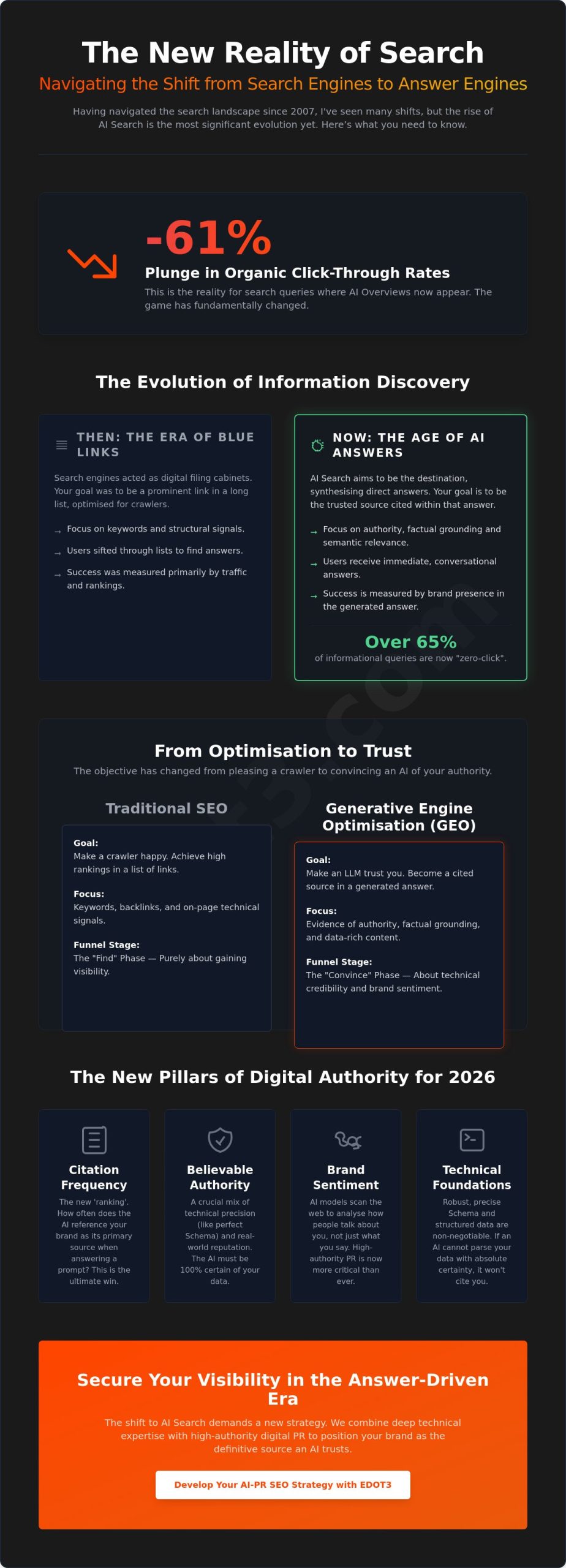
What if the search engine results page you have spent years optimising for no longer exists in the way you remember it? It is a blunt reality facing every business owner today. Organic click-through rates have plummeted by 61% for queries where AI Overviews appear, marking a seismic shift in digital behaviour. Having navigated the search landscape since 2007, I have witnessed many transitions, but the rise of AI Search is the most significant evolution of the open web to date.
You are likely feeling the pressure of declining traffic and the confusion caused by technical jargon like RAG and LLMs. It is a common frustration amongst marketing leaders who want results rather than fiddly bits. I promise that by the end of this article, you will understand how to master the shift from search engines to answer engines and secure your brand’s visibility in this new landscape.
We will explore how to maintain authority in generated answers and develop a strategy that survives increasing algorithmic complexity. You will gain a clear understanding of the new metrics required for search success in 2026.
Key Takeaways
- Understand how Large Language Models have redefined the path to visibility by shifting from indexing web pages to synthesising direct generative answers.
- Master the transition to Generative Engine Optimisation by prioritising the technical data grounding that AI Search platforms require to cite your brand.
- Discover why “Believable Authority” and human-in-the-loop insights are now the primary psychological triggers for maintaining trust amongst AI-generated noise.
- Learn the practical steps to conduct a rigorous Digital Health Check, ensuring your technical Schema is robust enough to survive increasing algorithmic complexity.
- Develop a future-proof strategy that combines PR-SEO methodologies to secure your position as a definitive source in an answer-driven landscape.
The Evolution of AI Search: From Blue Links to Generative Answers
Search engines used to be digital filing cabinets. You would type a keyword, get a list, and click a link. That era is dead. Generative artificial intelligence has flipped the script, moving us from indexing pages to synthesising complete answers. AI Search doesn’t just point you to a destination; it tries to be the destination. It is a fundamental shift in how information is served to your potential clients. Since 2007, I have watched search evolve, but nothing compares to this transition from search engines to answer engines.
According to Semrush data from April 2026, over 65% of informational queries on Google are now “zero-click.” This means users get what they need without ever visiting your site. If you are still obsessing over traditional traffic metrics, your data is lying to you. Raw sessions matter less than brand presence within the generated answer itself. User behaviour has evolved rapidly. People no longer want a list of blue links; they want a conversation. They are asking layered, complex questions and they expect the engine to keep up with the context whilst providing immediate value.
To better understand how these systems actually process your data, watch this helpful breakdown:
The Mechanics of Generative Search
LLMs like Google’s Gemini, Perplexity, and Claude are the new gatekeepers of your digital visibility. They operate using a process called Retrieval-Augmented Generation, or RAG. In simple, executive terms, RAG allows the AI to fetch specific, live facts from the web before using its language model to explain them to the user. This is why citation frequency is the new “ranking” in AI Search. If the AI cites your brand as its primary source whilst answering a prompt, you have won the visibility game. Previsible reported in 2025 that AI-sourced sessions grew by 527% year-over-year. You must be the source the AI trusts.
Why Traditional Keyword Stuffing is Dead
Forget the old SEO playbooks that relied on repetitive phrases and “fiddly bits.” LLMs are built to ignore low-value, over-optimised content that lacks real depth. They prioritise semantic relevance, meaning the AI understands the context and “why” behind a search, not just the “what.” It looks for authoritative, data-rich content that provides genuine value. If your content feels like it was written for a crawler rather than a human, the AI will simply skip it. AI search prioritises user intent over traditional technical signals every single time.
Generative Engine Optimisation (GEO) vs Traditional SEO
Traditional SEO is about making a crawler happy. Generative Engine Optimisation (GEO) is about making an LLM trust you. It is a subtle but brutal distinction. When a crawler visits your site, it looks for keywords and structural signals. When an AI search engine processes your content, it is looking for evidence of authority and factual grounding. You aren’t just trying to “Find” a user anymore; you are trying to “Convince” a machine that you are the definitive answer. This represents a massive shift in the search funnel. The old “Find” phase was purely about visibility. The new “Convince” phase is about technical credibility and brand sentiment.
Technical foundations like Schema and structured data have moved from the “nice to have” category to being absolutely non-negotiable. If an AI cannot parse your data with 100% certainty, it won’t risk citing you in its responses. It will hallucinate a competitor into existence instead. AI Search models decide which brands to trust by looking for “Believable Authority”—a mix of technical precision and real-world reputation.
The New Ranking Signals for 2026
AI models now use Brand Sentiment as a primary data point. They scan the entire web to see how people talk about you, not just what you say about yourself. High-authority PR and external citations now carry more weight than a thousand low-quality backlinks. We also have to consider how the Google Antitrust Fallout is forcing a move toward search diversity. AI models aren’t just looking at the top ten blue links; they are synthesising a broad range of signals to decide who represents the “truth” in any given niche. This is why a PR-SEO approach is so vital; it builds the external validation these models crave.
Data Grounding and LLM Trust
You must ensure your website data is digestible for AI crawlers. This means stripping away the fluff and focusing on data grounding. If your facts are buried in vague marketing speak, the model will struggle to extract them. Factual accuracy is your shield against being ignored. Those technical “fiddly bits” of SEO, like properly nested headers and clean JSON-LD, now have a direct impact on your AI Search visibility. If you don’t provide a clear, structured roadmap for the AI, it will find someone who does.
Maintaining visibility requires a ruthless focus on these exceptional foundations. If you are unsure where your current strategy stands, it might be time to book a digital health check to see where the gaps are.
Building Believable Authority Amongst the AI Noise
Standing out in a sea of synthetic content requires more than just high volume. It requires what I call Believable Branding. This isn’t just about a pretty logo or a catchy slogan; it’s a technical and psychological necessity for the modern era. LLMs are trained to recognise patterns, and they are becoming incredibly efficient at identifying and ignoring cheap, amateur AI content. If your strategy involves churning out low-value text, you are effectively invisible. To win at AI Search, you must demonstrate genuine expertise and human-in-the-loop insights that a machine simply cannot replicate.
High-end, intelligent creative marketing is now the only way to command attention. AI models favour content that provides unique perspectives and data-rich conclusions. When you provide exceptional foundations of knowledge, you give the AI something worth citing. Remember, brands cited within AI Overviews earn 35% more organic clicks than those that are left out. You don’t want to be the brand the AI ignores because your content looks like everything else on the web. You need to be the definitive source that the model cannot afford to overlook.
Content Architecture for AI Consumption
We organise content using a rhythmic Problem-Solution-Proof structure. It is a logical flow that LLMs can parse with zero friction. First, identify the specific pain point. Second, provide a detailed, expert-led solution. Third, offer the data-backed proof that validates your authority. This creates a clear roadmap for the AI to follow whilst synthesising an answer. This expert-led approach is the polar opposite of “Generic-SEO” content that focuses on keyword density over actual substance. Interestingly, Searching without AI is becoming a niche trend for power users who want raw data without the generative filter, proving that authentic, listed websites still hold massive value for high-intent audiences.
The Role of PR and Authority in AI Rankings
Citations are the new backlinks. If your brand isn’t being talked about in high-authority centres of influence, you don’t exist to an LLM. Digital PR is now a core component of search visibility because it drives the citation frequency that AI models use to measure trust. By building a robust digital footprint across multiple reputable platforms, you use algorithmic complexity to your advantage. You aren’t just optimising a page; you are optimising your entire brand’s reputation across the digital ecosystem. This is how you ensure that when an AI Search query happens, your name is the one the machine trusts to deliver the final word.
Practical Steps to Future-Proof Your Search Strategy
The time for theory is over. You need a concrete roadmap to ensure your brand survives the transition to answer engines. Since 2007, I have helped businesses navigate every major algorithmic shift, and the move to AI Search is no different. It requires a ruthless focus on what actually works. Follow these five steps to secure your digital future:
- Step 1: Conduct a Digital Health Check. You cannot fix what you haven’t diagnosed. Identify the technical gaps in your site structure that prevent LLMs from parsing your data efficiently.
- Step 2: Implement Advanced Schema. Use JSON-LD to ground your data. This provides the factual certainty that AI models require before they will risk citing your brand as a source.
- Step 3: Focus on Deep Subject Matter. Stop producing shallow “SEO filler.” Invest in intensely researched content that provides unique insights and human expertise that machines cannot replicate.
- Step 4: Audit Brand Sentiment. LLMs scan the web to see if you are “believable.” Ensure your reputation across third-party sites and centres of influence is positive and authoritative.
- Step 5: Monitor AI Citation Share. This is your new primary KPI. Measure how often your brand appears in generative answers compared to your direct competitors.
Auditing Your AI Visibility
You need to see your brand through the eyes of the machine. Use AI tools to query your own products and services whilst looking for “blind spots.” If a competitor is being cited for a topic you should own, you have a data grounding problem. Don’t ignore the growth of multimodal search either. Image searches on Google’s AI Mode are growing at over 40% month-over-month. Your strategy must be holistic, ensuring your visual and voice assets are just as discoverable as your text.
Reallocating SEO Budgets for 2026
Stop wasting money on low-level “fiddly bits” that don’t impact your bottom line. You must reallocate your budget toward building exceptional foundations. This means investing in high-end PR-SEO and technical architecture that survives algorithmic complexity. A Strategic Digital Agency must adapt to AI by moving beyond simple rankings and focusing on the holistic authority that drives generative citations. This level of strategy requires Director-level oversight, not a transient employee who might disappear next month. If you are ready to stop guessing and start dominating the answer engines, get in touch for a technical consultation.
Future-Proofing Your Visibility with EDOT3’s AI-PR SEO Strategy
Since I founded EDOT3 in 2007, I have watched the digital marketing industry get repeatedly distracted by superficial trends and “fiddly bits” that don’t drive revenue. Many agencies will sell you a pretty website that fails to convert or a technical strategy that crumbles under the weight of algorithmic complexity. We have evolved alongside every major search update to ensure our clients stay ahead of the curve. Our AI-PR SEO methodology is the definitive solution for UK leaders who need to dominate the AI Search landscape. It isn’t just about ranking; it’s about building an unshakeable, believable authority that machines and humans both trust.
The EDOT3 Digital Road Map
Success in the era of AI Search doesn’t happen by accident. We follow a highly structured, six-step Digital Road Map that leads you from initial Discovery through to Strategy, Implementation, Optimisation, and Growth, culminating in a clear ROI. This process is anchored by our foundational philosophy: Find, Convince, and Convert. We identify where your audience is hiding, convince them of your authority through believable branding, and convert that interest into revenue. One of our sharpest signatures is the promise of Director-level contact. You won’t be passed off to a transient employee; you work directly with senior strategists who are deeply committed to your investment.
Start Your AI Search Transformation
The transition from search engines to answer engines is the most significant shift we have faced in decades. If you aren’t visible in generative results today, you are effectively giving your market share to the competition. From our centres of digital excellence in Newcastle and London, we provide the aggressive, results-driven oversight needed to navigate this shift. Stop settling for standard marketing distractions and start building an exceptional foundation that survives the AI era.
Your first step is to stop guessing and start measuring. I invite you to book a Digital Health Check to assess your current readiness and identify the technical gaps your competitors are already exploiting. It is time to cut through the noise and secure your brand’s future. Contact us today to get optimised for success and leave the competition behind.
Master the Transition to Answer Engines
The move to AI Search represents a fundamental reordering of the digital landscape. It isn’t just about ranking anymore; it’s about becoming the definitive source that machines trust to synthesise an answer. We have transitioned from a world of signposts to a world of destinations where the engine itself provides the value.
To survive this shift, you must prioritise exceptional foundations over superficial marketing distractions. Success now depends on the technical precision of your data and the “Believable Authority” of your brand across the wider web. Those who adapt to these new metrics will find themselves cited whilst their competitors fade into obscurity amongst the noise.
It is time to audit your current search readiness and address the technical gaps in your digital architecture. Taking action now ensures your brand remains a pillar of trust in an increasingly synthetic environment. Don’t let your visibility be left to chance whilst the search funnel undergoes its most radical transformation yet.
Frequently Asked Questions
What is AI Search and how does it differ from traditional Google search?
AI Search synthesises complete answers using Large Language Models instead of simply listing indexed web pages. Whilst traditional Google search acts as a signpost to other destinations, these new engines attempt to be the final destination itself. It is a fundamental transition from basic keyword matching to a deep, conversational understanding of user intent.
Will AI Search replace traditional SEO entirely by 2026?
No, SEO is not being replaced; it is being redefined into a more technical and authoritative discipline. By 2026, the “fiddly bits” of keyword density will be irrelevant, but the exceptional foundations of site architecture and data grounding will be more critical than ever. SEO provides the raw, verified data that AI models need to function without hallucinating your competitors into existence.
How can I make my business appear in Google AI Overviews?
You appear in Google AI Overviews by becoming the most authoritative, cited source for a specific query. Google prioritises content that uses advanced Schema markup and clear, data-rich headers that follow a logical Problem-Solution-Proof rhythm. Brands that are cited in these overviews earn significantly more trust and clicks than those left in the traditional blue links.
What are the most important ranking factors for AI search engines like Perplexity?
Perplexity and similar engines prioritise citation frequency and the “Believability” of your brand across the wider web. They scan for factual accuracy and cross-reference your claims with other high-authority centres of influence. If your brand is frequently mentioned in reputable PR-SEO outlets, you are far more likely to be featured as a primary answer in an AI Search query.
Is it worth investing in SEO if AI answers everything on the results page?
It is absolutely worth it because the “zero-click” reality doesn’t mean zero opportunity. Being the trusted source behind an AI answer builds massive brand authority and captures high-intent users who require deeper information. Without a robust search strategy, you won’t even be in the pool of data the AI considers when generating its response.
How do I measure the success of my marketing in an AI-driven environment?
You must shift your focus from raw session counts to citation share and brand sentiment. Success in an AI Search environment is measured by how often your brand is cited as the definitive answer for your core keywords. Track your presence within LLM responses and monitor the quality of the traffic that does click through to your site.
Can I use AI to write my content and still rank in AI search results?
You can use AI as a tool, but raw, unedited AI content is a recipe for invisibility. LLMs are trained to recognise and ignore generic, synthetic text that lacks unique “human-in-the-loop” insights. To rank, your content must offer a “wow factor” and genuine expertise that a machine cannot generate on its own.
What is Generative Engine Optimisation (GEO) and why does it matter?
GEO is the technical evolution of SEO, focusing on making your content easily extractable and digestible for generative models. It matters because it bridges the gap between your raw data and the AI’s ability to synthesise it. Without a GEO strategy, your brand remains a “blind spot” for the models that your customers are increasingly relying on for answers.