


Why are you still pouring hours into blog posts that only your mother and a few stray bots ever bother to read? Most businesses treat their blog as a creative luxury, but if you aren’t treating content marketing as the technical engine of your search authority, you’re simply shouting into a void. It’s exhausting to watch your team produce volume whilst your conversion rates remain stubbornly flat. You’ve likely felt the sting of low engagement despite decent traffic, left wondering how the latest AI shifts are quietly burying your best work.
We’re here to cut through that noise and provide some much-needed clarity. You’ll learn how to master the technical and creative foundations required to find, convince, and convert your target audience with absolute authority. We’re going to lay out a clear digital roadmap that improves your authority signals for search engines and transforms your website into a lead-generating machine. This isn’t about fiddly bits or superficial aesthetics; it’s about building an exceptional foundation that AI search engines love and your customers find believable.
Key Takeaways
- Master the “Find, Convince, Convert” framework to ensure every piece of media drives profitable customer action rather than just filling space.
- Discover how technical search engine optimisation and keyword intent form the bedrock of visibility in an AI-driven search landscape.
- Learn to bridge the ROI gap by aligning your content marketing with specific audience pain points that trigger genuine conversions.
- Uncover a 6-step roadmap that utilises search data to ensure every blog post serves a strategic purpose in the buyer’s journey.
- Understand why high-performing content must be integrated into a holistic, director-led SEO strategy to build and maintain absolute authority.
What is Content Marketing? Defining the “Find, Convince, Convert” Framework
Stop thinking of your blog as a digital diary or a place to dump company news. True content marketing isn’t about vanity; it’s the strategic creation of media designed to establish absolute authority and drive profitable customer action. It’s a technical engine. It’s a psychological bridge. Most importantly, it’s a measurable asset that works when your sales team is asleep. If your content doesn’t have a clear purpose, it’s just noise.
To better understand how this strategy functions in a modern digital landscape, watch this helpful video on the evolution of content strategy:
Our framework simplifies the complex by focusing on three distinct phases. The “Find” stage is purely technical. It relies on AI Search Optimisation and a granular understanding of keyword intent to ensure your site appears exactly when a prospect asks a question. If you haven’t mapped your content to what people are actually searching for, you’ve failed before you’ve even started. You must align your expertise with algorithmic demand.
Once they’ve landed on your site, the “Convince” stage begins. This is where we deploy psychological triggers and “Believable Branding” to build trust. We move past the superficial to show the reader you actually know your craft. Finally, the “Convert” stage uses specific conversion design to turn that informed reader into a high-value lead. We aren’t just looking for clicks; we’re looking for ROI.
The Evolution from Traditional Advertising to Content Authority
Shouting at your audience doesn’t work anymore. In an age of ad-blockers and AI-driven search summaries, traditional “interruption” marketing is dying. Savvy businesses have shifted to “invitation” marketing. Instead of forcing a message onto a screen, you create an exceptional foundation of knowledge that pulls people in. You become the solution they were already looking for, establishing authority whilst your competitors are still paying for clicks that don’t convert.
Why British Businesses Must Prioritise High-Value Information
The Technical Engine: How Content Drives SEO Authority in 2026
Search engines and new AI-led platforms use your content to understand algorithmic complexity. They look for patterns, depth, and unique data points that prove you aren’t just a copy-paste outfit. This is where your overall SEO strategy lives or dies. High-quality content builds natural backlinks because other experts want to cite your findings, not because you’ve begged for a link. You’re feeding a machine that needs data whilst satisfying a human who needs a solution.
Entity Validation and AI Search Optimisation Strategy
Your business needs to be recognised as a trusted “Entity” by search engines. Content helps validate your brand as a reliable source of truth. As the Content Marketing Institute notes, this strategy must focus on attracting and retaining a clearly defined audience. In the age of generative search, AI assistants summarise your work to answer direct queries. If your content doesn’t provide clear, structured answers, you won’t be the one they cite. For a deeper dive into these technical mechanics, explore our approach to AI Search Optimisation.
PR-SEO: Using Content to Build National Reputation
Content creation and PR-SEO are two sides of the same coin. You need to craft stories that journalists and industry peers actually want to link to. This isn’t about boring press releases; it’s about proprietary data and expert takes that boost your domain authority through high-tier placements. This national reputation is what separates the winners from the also-rans. By focusing on stories that move the needle, you earn the kind of links that algorithms cannot ignore.
Your strategy must balance human readability with technical precision. You’re writing for a person who needs a solution, but you’re also feeding a machine that needs data. If you’re struggling to find that balance, it might be time to book a digital health check to see where your strategy is leaking value.
The ROI Gap: Why Most Business Blogs Fail to Convert
Traffic is a vanity metric. If you’re celebrating 10,000 monthly visitors whilst your bank balance remains unchanged, you’ve fallen into the ROI gap. Most business blogs fail because they prioritise volume over value. They focus on being seen rather than being useful. In this Content Marketing Guide for 2026, the focus remains on strategic alignment, yet many UK firms still treat their blog as a corporate megaphone. Stop shouting. Start solving.
The first mistake is the “Ego Trap”. You’re writing about what you find interesting rather than addressing a specific audience pain point. If your content doesn’t answer a burning question or solve a frustrating problem, it won’t convert. It’s that simple. Secondly, you’re likely ignoring the search intent of the user. A reader looking for a “how-to” guide is in a different mindset than someone searching for a “service provider”. If you treat every visitor like a hot lead, you’ll scare them off before they reach the “Convince” stage of our framework.
Finally, there’s the issue of poor conversion design. You’ve done the hard work of getting them to the site, but then you hide the next logical step. If your call-to-action is buried under three layers of “fiddly bits”, don’t be surprised when they bounce. You need clear, authoritative paths that guide the user from interest to enquiry. Content marketing should never be a dead end; it should be an invitation to take action.
Search Intent in the Age of AI Assistants
Understanding intent is no longer optional. You must distinguish between informational queries (learning), commercial queries (comparing), and transactional queries (buying). A blog post designed for informational intent should never be a hard sales pitch. Instead, it should establish you as the definitive authority. By mapping your content to the correct stage of the buyer’s journey, you ensure you’re providing the right value at the right time. For a deeper look at this mapping, read our guide on Search Intent in the Age of AI Assistants.
Exceptional Foundations: The Role of High-Conversion Web Design
Even the most brilliant content marketing cannot rescue a slow, clunky website. If your mobile-responsive experience is a mess, you’re flushing your content budget down the drain. Search engines and users alike demand speed and clarity. Before you invest another pound in content creation, you need to ensure your site is actually ready for traffic. We recommend a “Digital Health Check” to evaluate your technical foundations. If your site doesn’t convert, the content is just a distraction. Focus on the foundations first.
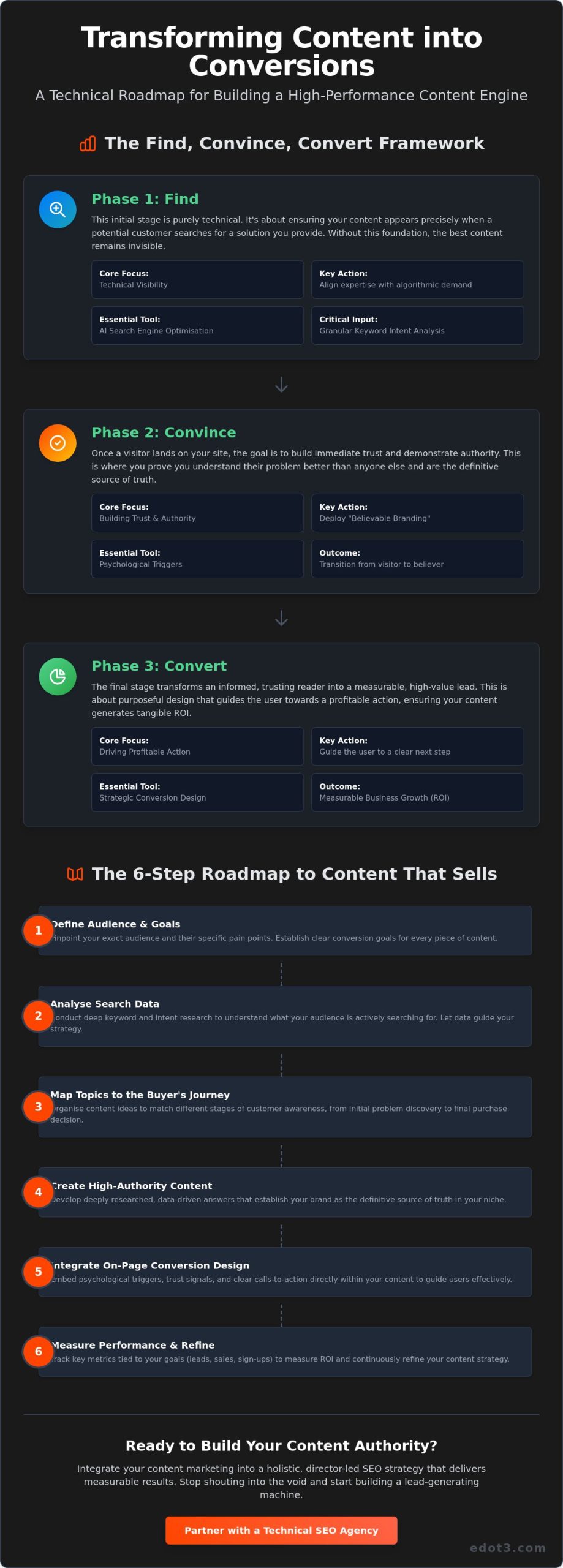
How to Write a Blog That Actually Sells: A 6-Step Roadmap
Most agencies treat blogging as a creative exercise. They focus on “storytelling” whilst ignoring the technical mechanics of a sale. If your content marketing isn’t designed to move a reader through a specific psychological journey, you’re just publishing digital clutter. Writing a blog that actually sells requires a disciplined, six-step roadmap that prioritises conversion over creativity. It’s about building a technical asset, not just a piece of prose.
- Step 1: Discovery. Stop guessing what your audience wants. Use search data and algorithmic insights to find the exact questions your prospects are asking.
- Step 2: Intent Mapping. Align your topic with the correct stage of the buyer’s journey. As we established earlier, an informational post should never feel like a desperate pitch.
- Step 3: The Authority Hook. Write a single, punchy sentence that defines your unique perspective. This is your “wow factor” that separates your expertise from AI-generated genericism.
- Step 4: Technical Execution. Optimise your headings, metadata, and internal linking structure. You’re building a site that search engines can crawl and humans can navigate with ease.
- Step 5: Conversion Design. Place contextually relevant CTAs that feel like a helpful next step rather than a jarring interruption.
- Step 6: Measurement. Track the transition from “Convince” to “Convert”. If a post gets traffic but zero enquiries, it’s a technical failure, not a creative one.
Crafting the Perfect Headline and
Integrating Content into Your Holistic SEO Strategy with EDOT3
Content marketing isn’t a one-off creative project. It’s a continuous technical engine that requires constant tuning to remain effective. For your strategy to deliver a real return, it must be integrated into a broader, monthly retainer for SEO management. Treating content as an isolated task is a mistake that leads to disjointed authority signals and missed ranking opportunities. We don’t just “write blogs”; we deploy optimisation technology to ensure your business maintains long-term dominance in a crowded digital marketplace.
Our approach is built on the “Find, Convince, Convert” triad. For businesses in Newcastle and London, this means moving beyond simple keyword stuffing to create a presence that actually commands attention. We help you find your audience through technical search marketing, convince them with expert insight, and convert them into high-value leads. It’s a holistic process that transforms your website from a static brochure into a proactive sales asset.
The Digital Road Map to ROI
We prioritise exceptional foundations over superficial marketing “fiddly bits” that don’t move the needle. Your digital road map is a strategic document that ensures every piece of media we create serves a specific purpose in your growth. Our AI Search Optimisation protocols ensure your content is ready for the future of generative search, making your brand the definitive answer to complex user queries. If you’re unsure where your current strategy is failing, we recommend a Digital Health Check to identify exactly where your growth opportunities lie.
Partnering with a Straight-Talking Strategist
You don’t need a transient employee who might disappear next month. You need a partner who has been “in the game” since 2007. At EDOT3, you work directly with a Director, ensuring your strategy never loses momentum or seniority. We combine technical SEO precision with “Believable, Loveable Branding” to create a presence that isn’t just visible, but trusted. We’re blunt about what works and even blunter about what doesn’t, protecting your investment whilst aggressively targeting your competitors.
Ready to get optimised for success? Stop wasting time on content that doesn’t convert and start building a foundation that lasts. Contact EDOT3 today to begin your journey toward absolute search authority.
Stop Wasting Words and Start Building Authority
You now understand how the technical mechanics of content marketing serve as the backbone of modern search authority. It isn’t enough to simply publish; you must align your expertise with algorithmic demand whilst guiding readers through a believable brand experience. We’ve moved past the era of “fiddly bits” and vanity metrics. Today, it’s about using optimisation technology to ensure your business is recognised as a trusted entity that AI search engines actually want to recommend.
Success requires a clear digital roadmap and a commitment to exceptional foundations. Don’t settle for transient employees who might disappear when things get complex. At EDOT3, we’ve been in the game since 2007, providing the director-level contact and technical precision needed to dominate your niche. We specialise in high-conversion web design and AI SEO that turns traffic into tangible ROI. It’s about building a legacy of search dominance that your competitors simply cannot ignore.
Get Optimised for Success with an EDOT3 Digital Health Check. It’s time to leave the noise behind and secure your place as the definitive authority in your industry.
Frequently Asked Questions
How long does it take for content marketing to start showing SEO results?
Expect to wait three to six months before you see measurable movement in your search rankings. Authority isn’t built overnight. It’s a cumulative process where technical foundations and high-quality assets work together to convince search engines you’re the definitive source. If you want faster results, you need to ensure your conversion design is rocking it from day one.
Can I use AI to write all my business blog posts in 2026?
How often should a UK business publish new content to stay competitive?
Quality is your primary metric, but aim for two to four exceptional pieces of content marketing every month. It’s better to publish one deeply researched, technical article that actually moves the needle than ten low-effort posts that nobody reads. Consistency keeps crawlers coming back, but depth is what secures your position against the competition.
What is the difference between content marketing and traditional SEO?
Traditional SEO handles the technical health and algorithmic complexity of your site, whilst content provides the substance those algorithms need to index. Think of SEO as the high-performance engine and content as the fuel. Without the engine, the fuel has nowhere to go; without the fuel, the engine is just an expensive ornament.
How do I measure the actual ROI of my content marketing efforts?
Track specific conversion events like enquiry form completions or whitepaper downloads to measure the ROI of your content marketing efforts. You need to use attribution modelling to understand how a blog post assisted a sale weeks later. ROI is found in the “Convert” stage of our framework, so focus on the data that actually impacts your bank balance.
Is content marketing still relevant for B2B service businesses in Newcastle?
It’s arguably more important for B2B firms in Newcastle to establish local entity validation through their content. Search engines look for regional signals to verify you’re a legitimate business before they trust you with national rankings. Deeply technical, local-focused content proves you’re a leader in your territory whilst building the domain authority needed to compete in London and beyond.
What happens if I stop publishing content for a few months?
Your search visibility will eventually enter a slow decay if you stop publishing. Competitors who are consistently active will start to leapfrog your rankings, and search crawlers will visit your site less frequently. Content is a momentum game. Once you lose that technical “heartbeat,” it’s much harder and more expensive to regain your previous authority.
Should I focus on local or national content for my search strategy?
You must do both to succeed in a modern search environment. Local content validates your business as a real-world entity, providing a secure foundation for your brand. National content allows you to scale your reach and capture high-volume commercial intent. Balance your roadmap to protect your local turf whilst aggressively targeting broader industry terms.