

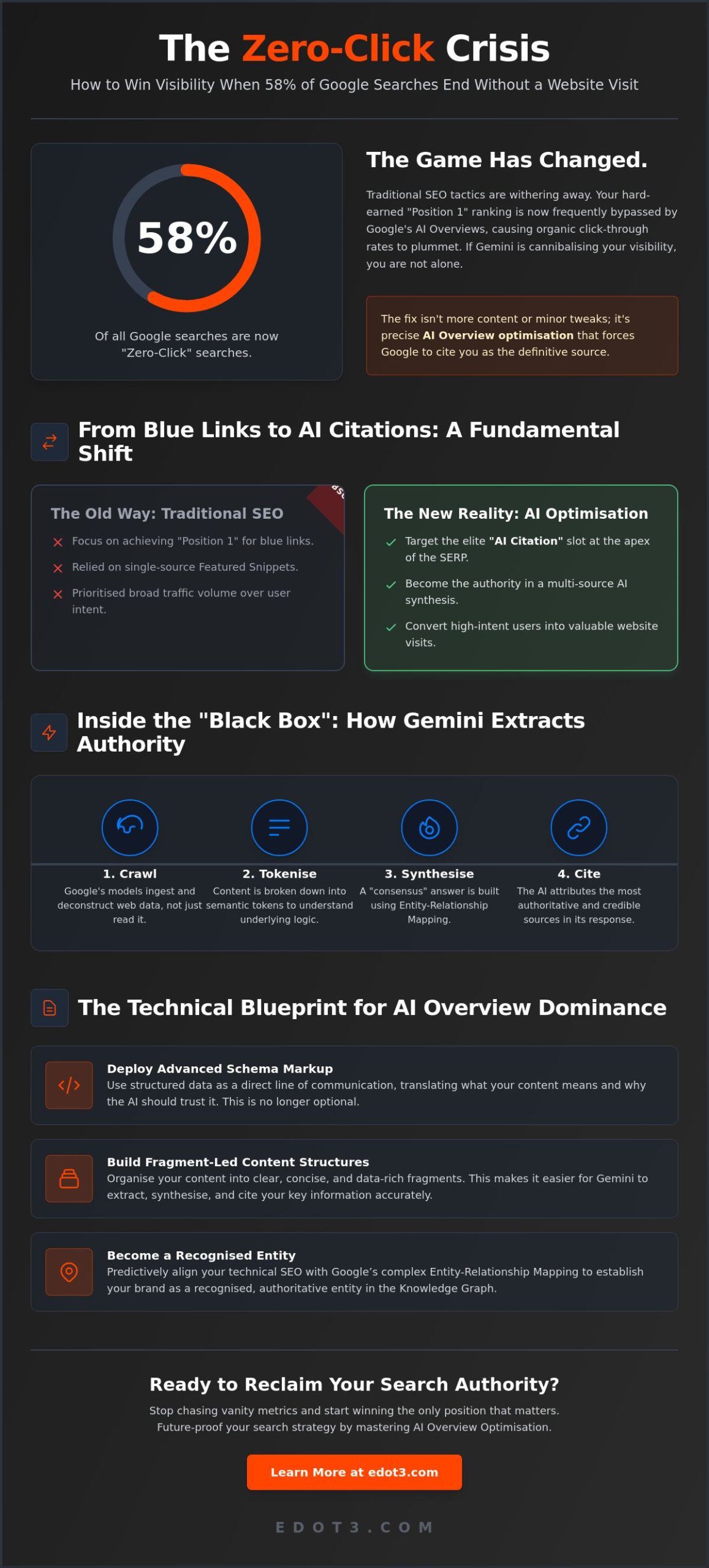
58% of Google searches now end without a single click to a website. It’s a brutal reality that’s left many marketing departments staring at plummeting traffic reports whilst their “old school” SEO tactics wither away. If you feel like Gemini is cannibalising your hard-earned visibility, you’re right. The game’s shifted, and the fix isn’t more content or fiddly bits; it’s precise AI Overview optimisation that forces Google to cite you as the definitive source.
You’ve likely seen your organic click-through rates drop significantly as zero-click searches become the new standard. It’s frustrating to watch your budget go towards rankings that no longer drive visits. We’re going to stop the bleeding. You’ll learn the technical mechanics of Google’s AI Overviews to reclaim your search authority and drive high-intent traffic in 2026. This guide breaks down how to master the “black box” of Gemini-driven rankings so you can convert AI citations into high-value website visits and ensure your brand remains the “wow factor” at the top of the page.
Key Takeaways
- Stop chasing traditional “Position 1” and start targeting the elite AI Citation slot to reclaim visibility in a zero-click search environment.
- Master the technical mechanics of how Gemini tokenises and synthesises your content to ensure your authority is correctly extracted and attributed.
- Deploy a precise blueprint for AI Overview optimization by leveraging advanced schema markup and fragment-led content structures.
- Debunk the myth of “random” AI results and learn to predictively align your technical SEO with Google’s complex Entity-Relationship Mapping.
- Future-proof your search strategy by shifting from broad traffic volume to high-intent conversions that turn AI summaries into valuable visits.
Beyond the Blue Link: Defining AI Overview Optimisation in 2026
The traditional search results page we’ve known since 2007 is effectively dead. Google has evolved into a generative powerhouse where AI Overviews (AIO) sit at the absolute apex. This isn’t just another “fiddly bit” for your marketing team to tweak; it’s a fundamental rewrite of how digital authority is displayed. If you aren’t appearing in that top-of-page summary, you aren’t just losing rank. You’re losing relevance. We’ve seen traffic patterns shift overnight as Gemini takes centre stage, and the brands winning are those that treat this as an entirely new tier of competitive real estate.
Traditional SEO obsessed over “Position 1.” In 2026, that’s a vanity metric. The “AI Citation” slot is the only real estate that matters for capturing high-intent clicks. Whilst your competitors fight for blue links that 58% of users now ignore, savvy brands focus on AI Overview optimization to become the source the Large Language Model (LLM) trusts. It’s a shift from being a destination to becoming the foundational data that powers the answer itself.
To better understand the technology driving this shift, watch this brief breakdown of Google’s latest generative capabilities:
The Shift from Search Engine to Answer Engine
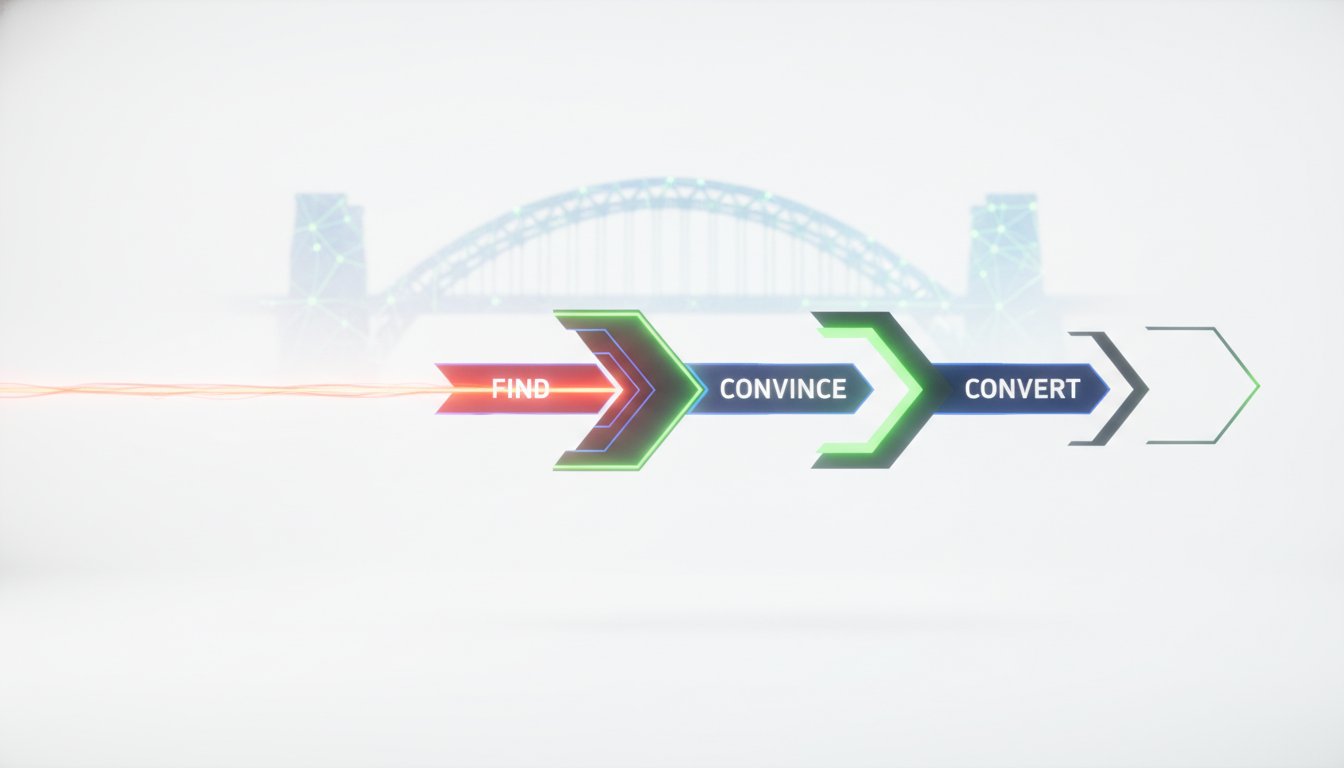
Google has transitioned from a directory to an answer engine because user behaviour has evolved to prioritise immediate utility. For informational queries, users don’t want to browse through ten different websites; they want a synthesised answer. However, for transactional intent, the AI summary acts as the ultimate gatekeeper. Our “Find, Convince, Convert” philosophy starts here. If the AI doesn’t find your data, you never get the chance to convince the user, let alone convert them into a customer. Ignoring this shift is a strategy for managed decline in the UK market.
AIO vs. Featured Snippets: The Technical Divide
AI Overviews represent a multi-source synthesis rather than a single-source extract. Unlike the featured snippets of the past, Gemini doesn’t just copy-paste a paragraph from one site. It crawls, tokenises, and synthesises a “consensus” answer from across the web. To get cited, your site needs more than just basic keyword density. You need semantic relevance and technical clarity that matches the algorithm’s entity-relationship mapping. This is precisely why AI Search Optimisation is now the bedrock of any serious digital roadmap. You must prove to the algorithm that your content is the most authoritative piece of the puzzle.
The Mechanics of Generative Search: How Gemini Extracts Your Authority
Gemini doesn’t read your website. It deconstructs it. To win at AI Overview optimization, you have to understand the pipeline: Crawl, Tokenise, Synthesise, and Cite. This isn’t the old-school indexing of the past. It’s a sophisticated process where Large Language Models for Information Retrieval break your content into semantic tokens to understand the underlying logic. If your technical foundations are messy, the AI simply skips you. It needs clean, high-authority data that it can synthesise into a 15-word summary without losing the plot.
Google has moved beyond simple keyword matching to Entity-Relationship Mapping. It wants to know exactly what your brand is and how it relates to other established “entities” in the Knowledge Graph. Are you a recognised authority, or just another site shouting into the void? To be cited, you must be a recognised entity. This is where structured data acts as your primary translator. Advanced Schema markup isn’t a “fiddly bit” anymore; it’s the direct line of communication that tells the AI exactly what your data means and why it should be trusted.
Citation Mapping and Source Credibility
Gemini is selective. The average AI response now includes 13.34 sources, and it prioritises those with the highest “trust score.” This isn’t just about your on-page content. It’s about your broader footprint. We use PR-SEO to build off-page signals that prove your authority to the algorithm. Being mentioned amongst industry leaders is far more valuable than a mountain of low-quality backlinks. Data from 2026 shows that brands cited in these summaries earn approximately 120% more organic clicks per impression compared to those left in the blue links. You want to be the citation, not the footnote.
Semantic Clustering: Moving Beyond Keywords
Stop obsessing over specific phrases. AI understands intent clusters. It groups your content based on the “next three questions” a user is likely to ask. If your site is organised into logical silos that answer these follow-up queries, you become the path of least resistance for the crawler. Effective internal linking helps the AI map your expertise across the entire domain. It’s about building an exceptional foundation of knowledge that the AI can’t help but use. If you want to see how your current site maps against these generative requirements, consider discussing your digital roadmap with us today.
Debunking the Myths: Why Everything You’ve Heard About AIO is Wrong
The panic surrounding zero-click searches has reached a fever pitch. If you spend any time on industry forums, you’ll hear that SEO is dead and Google has finally pulled the plug. It’s an emotional reaction. It isn’t a strategy. Whilst it’s true that 58% of Google searches now end without a click, the remaining traffic is becoming more valuable than ever. We need to move past the fear and look at the data. Successful AI Overview optimization isn’t about fighting the algorithm; it’s about understanding that the “randomness” your competitors complain about is actually a highly predictable set of technical requirements.
One of the most persistent myths is that only corporate giants get cited. In reality, Gemini often prioritises niche authority over corporate genericism. A massive brand with thin, broad content will lose every time to a smaller site that provides a precise, structured answer to a complex query. This is where E-E-A-T moves from being a “fiddly bit” to an exceptional foundation. AI trust isn’t built on brand name alone; it’s built on documented expertise and technical clarity. If you can prove your authority to the Knowledge Graph, you can out-manoeuvre competitors with ten times your budget.
The Zero-Click Fallacy
AIO doesn’t just “eat” clicks; it filters out tyre kickers. By providing immediate answers to low-value informational queries, Google is actually doing you a favour. It sends users who are further down the funnel and ready to engage directly to your site. Just as we saw when FAQ Rich Results died, Google isn’t removing utility; it’s centralising it. A citation in an AIO acts as a powerful third-party endorsement that builds immediate trust. Data shows that brands cited in these summaries earn approximately 120% more organic clicks per impression. You aren’t losing traffic; you’re gaining qualified leads.
The “Just Write Better Content” Trap
“Better” is a subjective term that leads to wasted budgets and fluffy copy. In the generative era, “better” means structured, technical, and measurable. AI crawlers don’t care about your creative adjectives; they care about fragment extraction and semantic relevance. If your content is a wall of text without clear H2 and H3 structures, Gemini will ignore it. You need to stop writing for “engagement” in the traditional sense and start writing for data-driven extraction. It’s about being the most useful piece of the puzzle in an era where fluff is a liability. Focus on the technical foundations, and the “wow factor” will follow in your ROI reports.
The Technical Blueprint: Optimising for Knowledge Graph Inclusion
Stop guessing. Winning the AI citation slot requires a rigid, technical framework that leaves no room for algorithmic ambiguity. Whilst your competitors are still obsessing over basic meta tags, you must focus on the signals that actually feed the Large Language Model. The first step in your blueprint is implementing advanced Schema markup. You need to deploy Organisation, Person, FAQ, and Product Schema to act as the primary translator for Gemini. This isn’t just about being indexed; it’s about being understood as a definitive entity within the Google Knowledge Graph.
The second pillar is optimising for “Fragment Extraction.” Gemini prefers content that it can easily deconstruct into bite-sized summaries. This means using clear, punchy H2 and H3 structures that answer specific queries directly. You are essentially pre-packaging your expertise for the AI. To support this, you must establish digital authority through high-authority SEO backlinks. External validation remains a massive weight in the citation algorithm, and without it, even the best-structured content will struggle to gain traction in 2026.
Finally, you must ensure your technical foundations are flawless. Improving Core Web Vitals is no longer just about user experience; it ensures AI crawlers can access and process your content without friction. Once these pieces are in place, you need to monitor your AIO appearances through Search Console and third-party trackers. This data-driven approach to AI Overview optimization allows you to refine your strategy based on real-world performance rather than guesswork.
Exceptional Foundations: Technical Search Engine Optimisation
Site speed and mobile responsiveness are the gatekeepers of AI extraction. If your site is sluggish, Gemini will simply move on to a faster source. A clean HTML structure is vital for AI tokenisation because it allows the model to map your content hierarchy without getting lost in the code. You must also avoid “fiddly” JavaScript issues that block content extraction. If the crawler can’t see the text immediately, it won’t synthesise it into an answer. If you’re concerned about your site’s technical readiness, you should discuss your technical search engine optimisation requirements with a specialist.
The Role of PR-SEO in AIO Dominance
Find, Convince, and Convert: The EDOT3 Approach to AI SEO
Since 2007, we’ve navigated every major algorithmic earthquake Google has thrown at the UK market. AI Overviews are simply the latest structural shift. At EDOT3, we combine 19 years of seasoned expertise with cutting-edge AI Search Optimisation to ensure your brand doesn’t just survive this transition but dominates it. Our approach to AI Overview optimization is built on the same no-nonsense principles we’ve used for nearly two decades. We don’t believe in superficial aesthetics or “fiddly bits” that offer no return. We build exceptional foundations. Our “Digital Road Map” isn’t a vague suggestion; it’s a precise, ROI-driven process that moves your business from a technical audit to tangible search authority.
You won’t be handed off to a junior account manager who might disappear next month. We prioritise Director-level contact because high-stakes search marketing requires senior accountability. This seniority ensures that your AI Overview optimization strategy is integrated with “Believable, Loveable Branding.” It’s one thing to get cited by Gemini; it’s another to convince that traffic to trust your brand once they arrive. We find the audience, convince them of your value, and convert them into loyal customers. It’s a holistic strategy designed to leave your competition behind whilst you reclaim your search authority.
Exceptional Foundations, Not Fiddly Bits
Our focus remains on high-impact strategies that actually move the needle for your bottom line. Whether it’s our technical team in Newcastle or our strategists in London, we collaborate to dominate the UK search landscape. We don’t waste time on distractions. We focus on the core technical signals that AI models crave and the conversion design that humans respect. If you want to see how we’ve helped brands truly rock it in search, take a look at our Work. We’ve spent years refining what works, and generative search is no exception.
Ready to Get Optimised for Success?
The first step to reclaiming your clicks is understanding where you currently stand. Your current SEO strategy might be hurting your long-term growth by ignoring the “black box” of Gemini-driven rankings. We offer a “Digital Health Check” to identify your specific AIO opportunities and stop the traffic bleed immediately. Stop settling for managed decline whilst your competitors adapt to the new reality of generative search. Take the first step toward a more assertive growth strategy and Contact EDOT3 today. Let’s build a roadmap that puts your brand back at the top of the page where it belongs.
Future-Proof Your Search Authority
You don’t have to navigate this shift alone or settle for junior account managers who don’t understand the stakes. We guarantee Director-level contact and a results-driven roadmap tailored to your specific ROI goals. As specialists in AI Search Optimisation, we’re ready to help you find, convince, and convert the high-intent traffic your brand deserves. Stop watching your visibility fade and start dominating the new search landscape. It is time to move from managed decline to assertive growth.
Book your Digital Health Check with EDOT3 today and secure your place at the top of the page. Let’s get to work.
Frequently Asked Questions
What is AI Overview optimisation?
AI Overview optimisation is the strategic process of structuring your digital presence so Google’s Gemini model extracts and cites your content as a primary source. It moves beyond simple keyword targeting to focus on semantic relevance and technical clarity. By aligning your data with the Knowledge Graph, you ensure your brand remains visible in the generative summaries that now dominate the top of the search results page.
Does Google AI Overview reduce website traffic?
It certainly changes the traffic mix by increasing zero-click searches for low-value informational queries. Whilst raw session numbers might dip, the users who do click through from an AI citation are typically further down the funnel and ready to engage. Data suggests that brands cited in these summaries see a significant boost in clicks per impression compared to those left in the standard blue links below.
How do I get my website featured in Google AI Overviews?
You need to prove your authority through an exceptional foundation of technical SEO and entity-based content. This involves using clear H2 and H3 structures that allow for easy fragment extraction by the AI crawler. Establishing your brand as a recognised entity in the Knowledge Graph through digital PR and high-authority backlinks is also essential for earning that coveted citation slot in the summary.
Can I opt out of Google’s AI Overviews?
There isn’t a “magic button” to opt out of AI Overviews specifically without affecting your traditional search visibility. You can use robots meta tags like nosnippet or data-nosnippet to limit what Google extracts, but this often results in a poor user experience and lower rankings overall. It’s a high-stakes game where hiding usually leads to a managed decline in your digital presence rather than protection.
What is the difference between AIO and SGE?
SGE, or Search Generative Experience, was the experimental playground where Google tested its generative capabilities. AI Overviews (AIO) is the official, global rollout of that technology into the live search environment. The transition marked the point where generative search moved from an optional lab feature to a foundational part of the search engine’s architecture across 200 countries and 40 languages.
How does Schema markup help with AI Overviews?
Schema acts as the direct translator between your website and the Large Language Models powering the search results. It removes the algorithmic complexity of “guessing” what your content means by providing structured facts about your organisation, products, and expertise. Implementing advanced Schema is a non-negotiable step in AI Overview optimization because it provides the clean, verified data that Gemini needs to build a consensus answer.
Is traditional SEO dead because of AI Overviews?
Traditional SEO isn’t dead, but the “fiddly bits” of old-school keyword stuffing certainly are. The core pillars of technical search marketing, such as mobile responsiveness, site speed, and secure architecture, are more important than ever. AI crawlers prioritise sites they can access without friction. If your technical foundations are weak, you’ll be skipped in favour of faster, more authoritative competitors who have adapted to the generative era.
How often do AI Overviews appear in UK search results?
Recent data indicates that AI Overviews appear in approximately 48% to 60% of search queries. They are particularly prevalent for informational searches, with queries of eight words or more being seven times more likely to trigger a generative response. This means that if your search strategy relies on long-tail informational traffic, you’re already operating in an environment where AI is the primary gatekeeper of visibility.