


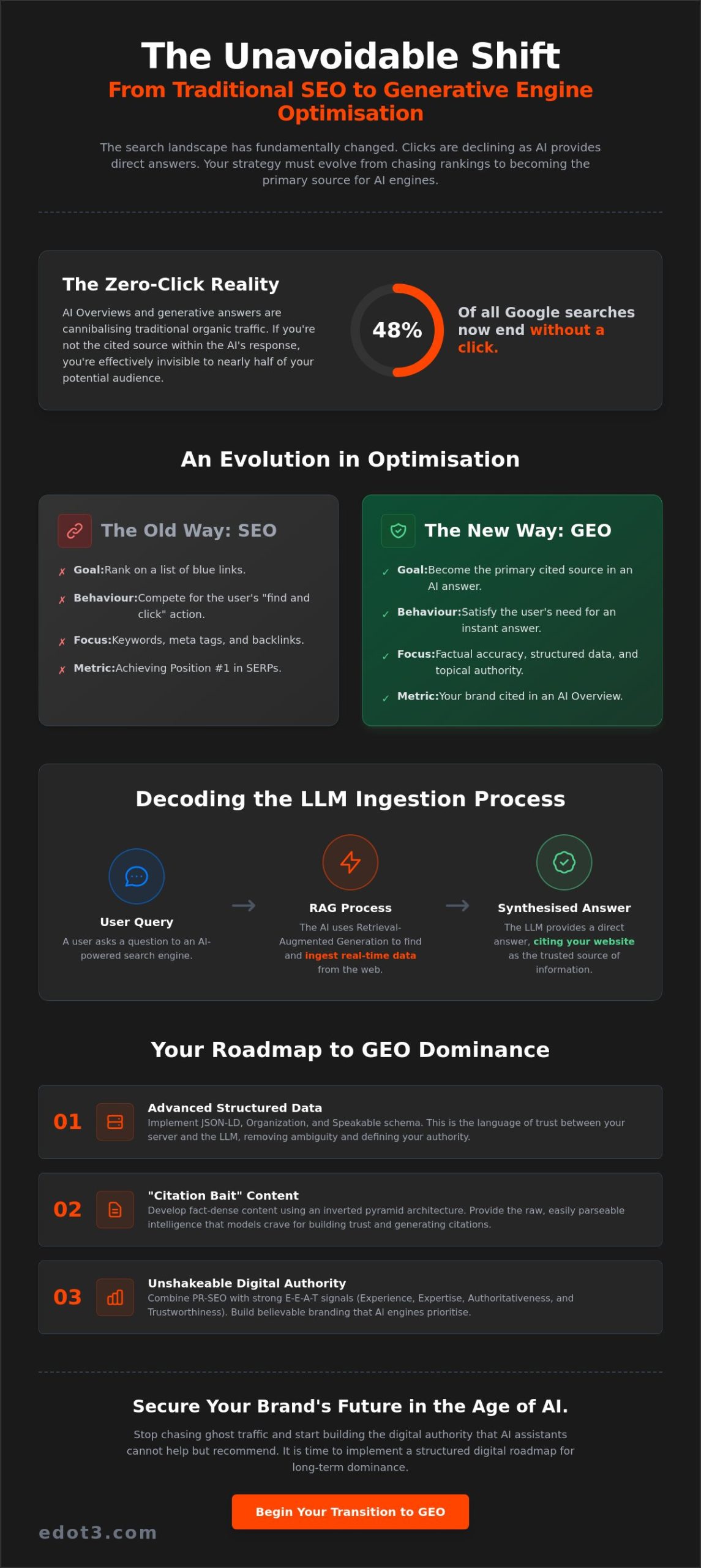
Nearly half of all Google searches now end without a single click, as Gemini 3.5 Flash serves up the answers before a user even considers scrolling. The data is clear; traditional SEO is being cannibalised by AI Overviews that provide instant solutions. You have likely felt the sting of declining organic traffic whilst your brand visibility hangs by a thread in this new zero-click environment. To reclaim your territory, your AI search optimization strategy must pivot from chasing blue links to becoming the primary citation that generative engines rely upon.
We know it is frustrating to see the rules of the game change overnight, leaving your hard-earned rankings feeling obsolete. This article promises to replace that confusion with a clear, technical roadmap for mastering Generative Engine Optimisation (GEO). We will explore how to secure citations in LLM responses and build the kind of digital authority that AI assistants cannot help but recommend. It is time to move past the fiddly bits and focus on the exceptional foundations that ensure your brand remains the definitive answer in the age of AI.
Key Takeaways
- Shift your focus from traditional SERP rankings to Generative Engine Optimisation (GEO) to ensure your brand remains visible in an answer-driven search landscape.
- Learn how to structure your data for Retrieval-Augmented Generation (RAG) so that LLMs can easily ingest and cite your content as a primary source.
- Deploy an advanced AI search optimization strategy using fact-dense “Citation Bait” and inverted pyramid architectures that appeal to algorithmic crawlers.
- Build unshakeable digital authority by combining PR-SEO with believable branding, providing the trust signals necessary for AI engines to prioritise your expertise.
- Transition from chaotic marketing distractions to a structured digital road map that secures long-term dominance across AI-native search platforms.
The Evolution from Keywords to Algorithmic Citations
Stop chasing ghost traffic. For nearly two decades, the industry lived and died by the position of a website in a list of results. We obsessed over rankings and fought for the top spot amongst the blue links. But in 2026, the game has changed fundamentally. Google AI Mode has surpassed one billion monthly users, and queries are doubling every single quarter. This isn’t just a minor update; it’s an extinction event for the lazy marketer. The old Search engine optimization (SEO) model was built on a “find and click” behaviour. Now, we’ve transitioned to an answer engine model powered by Perplexity and Gemini 3.1. These platforms don’t want to send users away. They want to synthesise the web into a single, authoritative response. If you aren’t the source of that answer, you’re invisible.
To better understand this concept, watch this helpful video:
Why Traditional “Blue Links” are Fading
Zero-click searches are no longer a myth. They are the reality for half of all Google queries today. AI Overviews now appear on roughly one in five searches, providing the “Convince” stage before a user even considers landing on your site. If the AI summarises your value proposition accurately, the user might not need to click through to your page at all. This makes your AI search optimization strategy more critical than ever. You aren’t just competing for a click. You’re competing for the user’s perception within the AI’s response itself. UK leaders who ignore this shift are effectively handing their market share to competitors who understand how to feed the models rather than just the index.
The Rise of Generative Engine Optimisation (GEO)
GEO is the technical discipline of making your content ingestible for Large Language Models. It moves beyond the “fiddly bits” of meta tags and focuses on sentiment, factual accuracy, and parseable signals. Models like Gemini 3.5 Flash prioritise clean, authoritative data over keyword stuffing. You need to provide the raw intelligence that these models crave to build trust. Generative Engine Optimisation serves as the bridge between structured data and LLM intelligence. Succeeding here requires a high-energy shift from keyword density to absolute topical authority. You must stop trying to “rank” and start trying to be the definitive source of truth that an algorithm cannot ignore. This is the only way to ensure your brand remains a primary citation in an automated world.
Decoding the LLM Ingestion Process
To win in 2026, you must understand that AI models don’t just search your site; they ingest it. Whilst traditional bots mapped links to build an index, agents like GPTBot and OAI-Search are looking for context they can use in Retrieval-Augmented Generation (RAG). This technical process is the backbone of every modern AI search optimization strategy. RAG allows models like GPT-5.5 and Gemini 3.5 Flash to pull real-time data from your pages to ground their responses in fact. If your technical search engine optimisation isn’t flawless, these models will ignore your data in favour of a cleaner, more accessible source. You cannot afford to be the brand that gets filtered out because of a messy crawl. These models are hungry for accuracy, and they weigh your site’s technical health as a proxy for the reliability of your information.
Structured Data and Schema for AI Extraction
AI crawlers prioritise clean, parseable signals that remove ambiguity. JSON-LD isn’t just a fiddly bit anymore; it is the primary language of trust between your server and the LLM. Advanced schema types help these models map relationships between your brand and the user’s underlying intent. This goes far beyond old-school AI Keyword Optimization. You are building a knowledge graph that an AI can verify and cite with confidence. When the data is structured correctly, the AI doesn’t have to guess what you do; it knows.
- Implement Organization schema to define your brand authority and link to trusted third-party profiles.
- Use Speakable schema to identify content specifically suited for voice assistants and AI narration.
- Ensure all structured data is valid and updated to the latest Schema.org standards to avoid ingestion errors.
The Role of API-First Content Delivery
Performance is non-negotiable for AI visibility. If your site relies on heavy JavaScript designs that hide content behind complex renders, you are failing the ingestion test. Semantic HTML remains the gold standard for AI crawling because it’s lightweight and easy to parse. Many high-growth firms are moving toward headless CMS structures to ensure their content is delivered as pure, structured data via an API. This speed and clarity allow AI agents to scrape and process your information in milliseconds. High-performance web design directly impacts how often and how deeply these models crawl your site. If your technical foundation is sluggish, you’ll be left behind by faster, leaner competition. If you’re unsure where your technical foundations stand, it’s worth having an expert review your digital health to ensure you’re ready for the LLM era.
Building a Citable Content Architecture
Stop hiding the lead. If your most valuable insights are buried under five paragraphs of introductory fluff, AI models will simply skip them. To win in 2026, you must adopt an inverted pyramid structure that delivers the core answer in the very first sentence. LLMs are designed for efficiency; they want the “what” and “how” immediately to satisfy their retrieval protocols. This approach provides fact-dense, unique data points that act as “Citation Bait.” When you publish original research or proprietary data, you offer the ultimate currency for AI engines. These models are programmed to cite sources for specific, verifiable claims. By being the primary source of a fresh statistic or a unique technical insight, you ensure your brand is the one credited in the AI Overview. This is a non-negotiable pillar of any serious AI search optimization strategy.
Conversational Query Mapping and Intent
User behaviour has shifted from fragmented keywords to full-sentence dialogue. You must anticipate the user-AI interaction by mapping out the natural progression of a conversation rather than just targeting a single phrase. It is no longer enough to answer one query. You need to structure your content to address the inevitable follow-up questions that AI assistants suggest at the bottom of the response. This approach moves beyond simple discovery and enters the “Convince” stage of the funnel. By providing a logical flow of information, you guide the AI to keep referencing your site as the user’s conversation deepens. This methodology is central to the philosophy of The Strategic Digital Agency, where we focus on finding and converting users through high-authority content that stands up to algorithmic scrutiny.
Data Visualisation as Citation Bait
Modern AI models are multimodal, meaning they “see” and “understand” the web with incredible precision. Unique charts, graphs, and diagrams are high-value targets for citations because they provide instant clarity to complex problems that text alone cannot solve. Your ALT text and captions should never be an afterthought; they are the technical signposts that help an AI engine parse your visual data correctly. We advocate for “loveable branding” that carries a technical edge. High-impact, original visuals don’t just look good for your human visitors. They serve as authoritative proof that AI models can easily extract and display to the user. To maintain your edge, ensure every visual is backed by clean metadata and descriptive text that reinforces your primary message. This makes your site the obvious choice for an AI looking to illustrate a point with a credible, citable source.
Brand Authority and E-E-A-T in the AI Era
Authority isn’t built in a vacuum. You’ve handled the technical ingestion and the content architecture, but if the AI doesn’t trust your name, it won’t risk citing you as a source of truth. This is where “Believable Branding” becomes your most potent filter against algorithmic invisibility. AI engines are increasingly sophisticated at spotting misinformation and generic fluff. They look for consensus across the web to validate your claims. If your brand is consistently mentioned on high-authority UK news sites or respected industry journals, you’ve provided the ultimate proof of expertise. This validation is a core component of a modern AI search optimization strategy. It moves your brand from a mere result to a trusted entity within the global Knowledge Graph.
PR-SEO: The Secret Weapon for AI Citations
Digital PR is no longer just about backlink counts or superficial coverage. It’s about building the “Convince” layer for AI models that are scanning the web for credible mentions. When you utilise PR-SEO, you are creating a digital footprint that LLMs can actually verify and weigh against your competitors. These models crawl news archives, press releases, and reputable third-party reviews to understand who the real experts are in any given niche. Third-party validation acts as a trust signal that overrides generic, self-published content. Digital PR creates the authority signals AI engines crave by placing your expert insights on platforms that the algorithms already trust implicitly.
The Human-in-the-Loop Advantage
Generic AI-generated content is everywhere. It’s safe, it’s repetitive, and it’s rarely cited by other AI engines. Why? Because it lacks the “Experience” part of the E-E-A-T framework. AI engines prioritise unique perspectives and assertive expert opinions that only a human can provide through lived experience. This is why we insist on “exceptional foundations” in brand storytelling. You need to inject real-world case studies and senior-level expertise into every piece of content you produce. When a Director provides a bold take on a technical subject, it carries a weight that a chatbot simply cannot replicate. This human-in-the-loop approach ensures your brand isn’t just another voice in the noise. It positions you as a leader that commands respect from both humans and algorithms alike.
Don’t leave your brand’s authority to chance whilst your competitors are busy building their digital footprint. If you want to see how your current authority signals measure up against the latest LLM trust requirements, speak directly with a Director today to begin your authority audit.
Implementing Your AI Search Optimisation Strategy
Dominating the AI-driven search landscape isn’t about luck. It’s about a relentless, high-energy execution of a structured Digital Road Map that leaves no room for error. To succeed in 2026, you must bridge the gap between technical search engine optimisation and creative branding. Most agencies get bogged down in the fiddly bits whilst ignoring the exceptional foundations required for LLM ingestion. We move beyond simple discovery to focus on the “Find, Convince & Convert” triad. Your AI search optimization strategy must guide users through a seamless journey, from Top-of-Funnel awareness in an AI Overview to Bottom-of-Funnel conversion on your high-performance site. This level of algorithmic complexity demands Director-level strategy, ensuring your investment is protected by seasoned experts rather than transient staff who can disappear at any moment.
We’ve been in the game since 2007, and we’ve seen search evolve from simple keywords to the sophisticated answer engine model we face today. Navigating this shift requires a partner who treats your brand authority as a technical asset. By combining rigorous data structures with believable, loveable branding, we ensure that AI models don’t just find you; they prefer you. You’re no longer just competing for a spot in a list. You’re competing to be the definitive source of truth that an AI assistant presents to your potential clients with absolute confidence.
Measuring ROI in a Zero-Click World
Success in the age of AI assistants requires a fundamental shift in your KPIs. If you’re still obsessing over traditional click-through rates whilst ignoring how often you’re cited by name, you’re measuring the wrong things. You must track your “share of model” and citation volume across platforms like Perplexity and Gemini 3.5 Flash. We utilise advanced AI-SEO tools to monitor brand sentiment and visibility within LLM responses. This data-driven approach allows us to refine your content architecture in real-time, ensuring you remain the primary answer for your industry’s most valuable queries. The long-term value of being a citable authority is far greater than any temporary spike in traffic from a fading blue link.
Next Steps: The EDOT3 Digital Health Check
It is time to evaluate whether your current strategy is built for the future or stuck in the past. The rules of the game have changed, and your business deserves a search engine optimisation firm that actually understands the nuances of generative engine optimisation. We invite you to undergo our Digital Health Check, a comprehensive audit designed to identify gaps in your authority and technical readiness. Don’t settle for standard marketing distractions when you could be building a foundation for total search dominance. Contact EDOT3 today to speak directly with a Director and begin your transformation into a primary AI citation.
Future-Proof Your Brand for the AI Search Era
The landscape of search has shifted permanently from a list of links to a stream of answers. To stay visible, your focus must move from simple keyword rankings to becoming the primary citation that LLMs trust implicitly. By mastering technical ingestion through RAG and building a content architecture designed for citation, you ensure your brand isn’t just found; it’s recommended. Authority and E-E-A-T are no longer just guidelines; they are the technical filters that determine your survival in a zero-click environment.
Executing an effective AI search optimization strategy requires more than just superficial content updates. It demands the kind of senior-level expertise that understands algorithmic complexity from the ground up. Since 2007, we’ve helped businesses navigate every major shift in search marketing. Our Director-led strategy and proven “Find, Convince & Convert” methodology are designed to turn technical foundations into believable branding that converts. It is time to stop worrying about declining clicks and start dominating the responses that matter most to your bottom line. Get Optimised for AI Success with EDOT3 and lead your industry into the future with confidence.
Frequently Asked Questions
What is the difference between traditional SEO and AI search optimisation?
Traditional SEO focuses on positioning a website amongst the blue links to drive organic clicks, whilst AI search optimisation aims to become the definitive source of truth that LLMs synthesise into their direct answers. Traditional methods rely heavily on keyword density and link volume. AI optimisation prioritises technical ingestion readiness, factual density, and the ability to serve as a primary citation for generative engines.
How do I get my business cited by ChatGPT and Perplexity?
Securing citations in ChatGPT or Perplexity requires you to publish unique, verifiable data that these models can use to ground their responses. You must ensure your site is easily crawlable by agents like GPTBot and that your content follows an inverted pyramid structure that puts facts first. High-authority third-party mentions across the web also act as a trust signal that encourages models to reference your brand.
Does structured data still matter for AI-driven search engines?
Structured data is more important than ever because it provides a clean, unambiguous map for AI agents to understand your brand’s entities and relationships. JSON-LD allows LLMs to extract specific facts and map your authority without the noise of a full page render. Without robust schema, you’re forcing the AI to guess your context, which significantly reduces your chances of becoming a citable source.
Can I use AI to write my content and still rank in AI search?
You can use AI as a tool, but relying on pure AI-generated content often leads to a lack of unique “Experience” and perspective, which are critical for citations. LLMs prioritise original research and assertive expert opinions that ground a response in reality. If your content is simply a rehash of existing training data, the AI has no reason to cite you as an authoritative source.
How much does an AI search optimisation strategy cost for a UK business?
The investment for a comprehensive AI search optimization strategy depends entirely on your current technical health and the level of PR-SEO required to build digital authority. Most UK businesses choose between monthly retainers for ongoing citation management or project-based technical audits to fix their foundations. You should focus on a strategy that prioritises long-term ROI and brand visibility over low-cost, superficial fixes.
Is Google Gemini different from standard Google Search for SEO?
Google Gemini operates as an answer engine that synthesises information into a conversational response, whereas standard Google Search primarily provides a ranked list of external links. Whilst they share an underlying index, Gemini’s retrieval protocols weigh factual density and brand authority differently. Your AI search optimization strategy must account for these synthesis patterns to ensure you appear within the AI Overview.
What are the most important citation signals for LLMs in 2026?
Factual accuracy and third-party validation are the most critical signals for LLM citations in 2026. Models look for consensus across reputable news sites and industry journals to verify the reliability of a claim. Sentiment also plays a massive role; an AI assistant is more likely to cite a brand that is consistently associated with positive, expert-led dialogue across the wider digital footprint.
How do I track my brand visibility in generative search results?
Tracking visibility in generative search requires a shift from traditional ranking trackers to tools that measure “share of model” and citation frequency. You need to monitor how often your brand appears in AI Overviews and the sentiment of the language used to describe your expertise. This involves a mix of automated monitoring and manual testing across different AI assistants to ensure your authority is holding steady.

Article by
Ian Shield
Director at EDOT3 since 2007