

What if the coveted top spot on Google no longer guaranteed the lion’s share of your traffic? It’s a sobering reality in 2026, especially since data shows that organic click-through rates for the number one result plummet by 34.5% the moment an AI Overview takes centre stage. You’ve likely noticed your traditional rankings holding firm whilst your actual leads start to dwindle, leaving you caught in the crossfire of Gemini 3.5 Flash updates and the new intelligent Search box rollout. It’s an exhausting cycle of trying to keep pace with algorithmic complexity without a clear path forward.
We’re here to cut through that noise and help you master a robust AI SEO Strategy that prioritises entity validation over old-school keyword stuffing. You’ll learn exactly how to transition from chasing legacy rankings to securing dominant AI visibility, ensuring your brand becomes the trusted citation that LLMs rely on. This article provides a straight-talking strategic roadmap for 2026, moving you beyond superficial fiddly bits to establish the kind of exceptional authority that future-proofs your search presence against any generative shift. It’s time to find your audience, convince the algorithms, and convert the new wave of search traffic.
Key Takeaways
- Recognise why traditional search rankings are becoming obsolete and how to navigate the fundamental transition toward AI Overviews and Answer Engines.
- Utilise advanced Schema Markup and structured data to provide AI crawlers with the technical foundations they need to validate your brand as a primary entity.
- Master a future-proof AI SEO Strategy by shifting focus from legacy keyword density to intent-led content that secures authoritative citations in LLM responses.
- Identify and bridge critical visibility gaps in generative search by conducting a rigorous Digital Health Check to assess your current search authority.
- Compare the ROI of automated content versus human-led, AI-enhanced tactics to ensure your brand maintains believable, high-performance search visibility.
The Paradigm Shift: Why Traditional Search is Becoming Obsolete
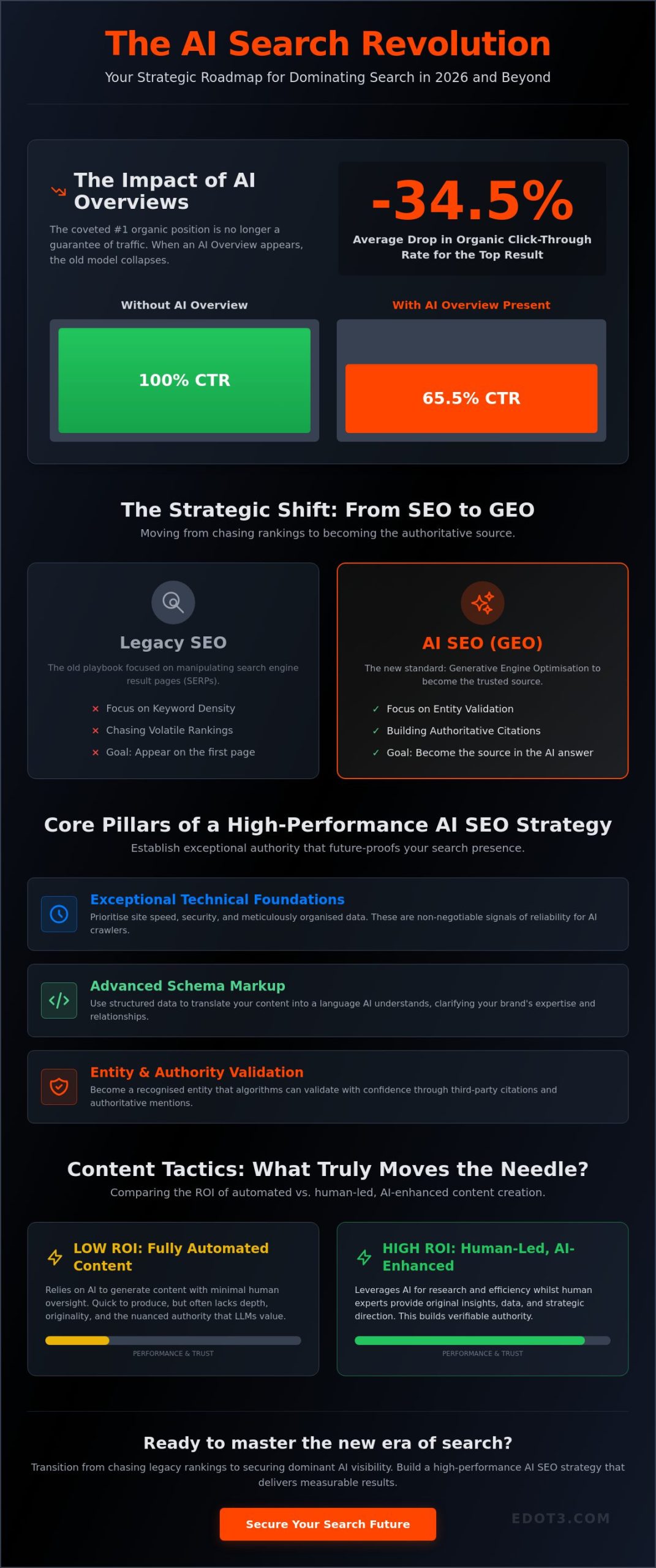
The traditional search landscape is effectively obsolete. If you’re still obsessing over keyword density and minor meta-tag tweaks, you’re fighting a losing battle against a machine that has already moved on. The May 2026 Core Update, which concluded its rollout on 2 June, made it clear that Google is prioritising content that satisfies intent over legacy SEO hacks. We’ve seen organic click-through rates for the top spot drop by an average of 34.5% when an AI Overview is present. This isn’t a minor dip; it’s a fundamental collapse of the old traffic model that UK businesses have relied upon for decades.
To survive this shift, you’ll need a high-performance AI SEO Strategy that aligns your content with how Large Language Models (LLMs) actually process information. We’re moving rapidly from a world of “Search Engine Results Pages” to one dominated by “Answer Engines” and generative summaries. With Google’s AI Mode now surpassing one billion monthly users, the goal is no longer just being “on the first page.” The goal is being the source that the AI cites. Stop wasting time on the “fiddly bits” of old-school optimisation and start building the exceptional foundations required for generative visibility.
To better understand this concept, watch this helpful video:
From Keywords to Entities: The New Search Currency
Modern search engines like Gemini 3.5 Flash don’t just index your pages; they attempt to understand your brand as a distinct entity. They use sophisticated Entity Linking to connect your business to established Knowledge Graphs, verifying your expertise across the entire web. If your brand isn’t verifiable through third-party citations, industry databases, and authoritative mentions, you won’t clear the bar for AI trust. Authority is now a web-wide signal. It’s about being a recognised entity that the algorithm can validate with absolute confidence.
The Rise of Generative Engine Optimisation (GEO)
Generative Engine Optimisation (GEO) is the technical response to this new reality. Whilst traditional SEO focused on ranking for specific strings, GEO prioritises becoming the definitive citation within an AI response. This requires a shift in how you organise your technical data. Success is now measured by citation frequency and the “verifiability” of your data points. It is a shift from being a destination to being the underlying truth that powers the answer. If you aren’t being cited, you are essentially invisible to the massive audience now using the intelligent Search box for their daily queries.
The Core Pillars of a High-Performance AI SEO Strategy
Building a successful AI SEO Strategy requires moving far beyond the superficial “fiddly bits” of traditional marketing. You cannot simply sprinkle keywords over a page and hope for the best. In 2026, visibility is earned through exceptional foundations: speed, security, and meticulously organised structured data. These aren’t just technical checkboxes; they are the signals that tell an AI crawler your site is a reliable source of truth. If your site is slow or your data is messy, an LLM will simply bypass you in favour of a more coherent competitor.
Advanced Schema Markup is the bridge between your content and an AI’s understanding. Whilst humans read your prose, AI crawlers read your intent through code. By using specific entity-based Schema, you provide the context needed for Google’s Gemini 3.5 Flash to “read” your brand’s relationship to its industry. This technical precision reduces the risk of AI hallucinations and ensures your brand is cited accurately. Without this underlying architecture, even the most brilliant content remains a black box to generative search engines.
Original, data-driven research is your strongest weapon against synthetic content. AI models are trained on existing data; they cannot conduct new experiments or provide unique market insights. By publishing proprietary data or first-hand case studies, you create “un-hallucinatable” value. This makes your brand an indispensable node in the Knowledge Graph. If your technical foundations are currently shaky, you should speak with a strategist to identify the gaps before the next core update hits.
Technical Architecture for AI Crawlers
Your site structure must facilitate deep, frictionless crawling. Implementing an llms.txt file is now a standard requirement, providing a clear map for AI agents to parse your most valuable assets. Minimise your reliance on heavy JavaScript execution. AI bots often struggle with execution delays, and if they can’t render your content instantly, they won’t index your entities. Focus on Core Web Vitals to meet the speed demands of real-time generative search, ensuring your data is ready for the intelligent Search box the moment a query is made.
EEAT in the Age of Synthetic Content
Experience, Expertise, Authoritativeness, and Trustworthiness (E-E-A-T) are the primary defences against the March 2026 core update penalties. With organic traffic dropping by up to 35% for sites relying on scaled AI spam, proving human expertise is non-negotiable. Use robust author bios and clear digital footprints to anchor your content in reality. We recommend leveraging PR-SEO to build high-authority third-party validation. When external, reputable sites cite your experts, it provides the cross-web verification that LLMs require to validate you as a top-tier entity.
Comparing AI Optimisation Tactics: What Actually Moves the Needle?
Stop chasing vanity metrics. If you’re still obsessing over where you rank for a specific keyword string whilst ignoring your citation share, you’re essentially reading a dead map. In 2026, the gap between traditional keyword-led content and intent-led generative content has become a chasm. Results matter most. Whilst old-school tactics focus on “matching” a query, a sophisticated AI SEO Strategy focuses on “solving” it. This shift is mandatory because LLMs don’t just look for words; they look for the most authoritative entity to validate an answer. If you aren’t that entity, you don’t exist in the generative response.
The ROI on automated AI content is currently plummeting. Following the March 2026 core update, sites that used AI to churn out low-value blogs at scale saw organic traffic drop by 20% to 35%. Contrast this with a human-led, AI-enhanced approach that prioritises original data and expert insight. This is the “Find, Convince, Convert” mindset in action. You find the intent, convince the algorithm of your authority, and convert the user through believable branding. Brand mentions and verifiable citations have now superseded simple backlinks as the primary signal of trust within the Knowledge Graph.
Traditional SEO vs. Generative Engine Optimisation
The metrics of success have fundamentally changed. We’ve moved from monitoring Click-Through Rates (CTR) on blue links to measuring your “Citation Share” within AI Overviews. With the top organic result losing 34.5% of its CTR when an AI summary appears, chasing “volume” is a fool’s errand. You must prioritise relevance. Generative Engine Optimisation (GEO) is the art of becoming an AI assistant’s primary source. It requires a move away from broad topics toward hyper-specific, intent-driven content that answers the complex queries now being entered into the intelligent Search box.
AI Tools for Execution vs. AI Strategy for Growth
There is a massive distinction between using AI to “churn out blogs” and using it to “analyse algorithmic complexity.” Most agencies fail because they focus on the former, treating AI as a cheap typewriter rather than a strategic engine. Real growth comes from using AI to identify visibility gaps and map out entity relationships. We recommend reviewing this AI search optimisation strategy for a deeper look at how intent analysis has evolved. A Director-level strategy doesn’t just use tools; it builds a digital roadmap that ensures your brand remains the definitive answer in a world of synthetic noise.
Implementation Roadmap: Transitioning to Generative Engine Optimisation
Transitioning to a high-performance AI SEO Strategy isn’t a weekend project. It requires a structured, aggressive approach to ensure your brand isn’t left behind by the intelligent Search box rollout. We start with a Digital Health Check to expose exactly where AI assistants are currently ignoring your brand. You can’t fix what you can’t see. Once the gaps are identified, we move into deep technical work, implementing advanced Schema and entity-based structures to give LLMs a clear, verifiable map of your authority. This is about building exceptional foundations, not just tweaking the fiddly bits of your meta data.
Content must be un-cloneable to survive in a generative environment. If an AI can hallucinate your value proposition, you’ve already lost. We focus on developing a content strategy that prioritises proprietary data and unique brand perspectives that LLMs are forced to cite because the information doesn’t exist elsewhere. This is followed by aggressive PR-SEO to build the external citations that validate your entity. Authority is built in the spaces between websites, and these third-party validations are what convince the algorithm that your business is the definitive answer.
Monitoring the Metrics That Matter
Tracking success in 2026 means moving beyond simple keyword rankings and focusing on your “Share of Model.” This involves analysing referral traffic from platforms like ChatGPT and Perplexity to identify which AI agents are actually driving high-intent users to your site. We also measure citation sentiment. It isn’t enough to be mentioned; you need to ensure the AI describes your brand with the appropriate level of authority and expertise. We use your Search Console data to isolate AI-generated impressions, allowing us to identify which specific entities are triggering generative summaries and where your visibility is strongest.
Iterating for Algorithmic Complexity
Algorithmic complexity is a moving target that requires constant attention. An effective AI SEO Strategy is never a one-off task; it requires a dedicated monthly retainer to handle continuous performance monitoring and campaign adjustments. The May 2026 Core Update proved that Google’s systems are evolving faster than ever, rewarding those who treat search as a dynamic conversation rather than a static billboard. Your digital roadmap must include regular technical audits to ensure all content remains mobile-responsive and perfectly optimised for voice-activated AI assistants. If you’re ready to stop guessing and start winning in the generative era, book your Digital Health Check today.
The EDOT3 Approach: AI Search Strategy with Director-Level Authority
We’ve been refining search marketing since 2007, long before AI became the industry’s loudest buzzword. At EDOT3, we don’t hide behind jargon or delegate your growth to junior employees who might vanish next month. You work directly with a Director. This level of seniority ensures your investment is protected by seasoned expertise and an aggressive commitment to outperforming your competitors. Our approach is built on a simple, powerful triad: Find, Convince, and Convert. In the context of a modern AI SEO Strategy, this means ensuring your brand is found by LLMs, convinces them of its authority, and ultimately converts the human user through believable branding.
Success in 2026 requires more than just technical precision; it demands a fusion of high-end technology and raw creativity. We don’t just build for bots. We build for the people who use them. By focusing on exceptional foundations rather than superficial distractions, we deliver a search presence that is both technically robust and emotionally resonant. This is how we move the needle. We act as your strategic partners, cutting through the noise to deliver meaningful ROI that standard agencies simply can’t match. We’re passionate about results, not just reports.
Our Digital Road Map for AI Dominance
Our methodology follows a clear, six-step Digital Road Map that takes you from initial Discovery to exceptional ROI. We start by stripping away the “fiddly bits” that clutter your site and focus on the technical search engine optimisation that AI crawlers demand. Our AI SEO services are designed to align your data with the Knowledge Graph, ensuring you aren’t just another indexed page but a validated entity. However, technical authority is only half the battle. We integrate “Believable, Loveable Branding” into every campaign, ensuring that once an AI assistant recommends your business, the user finds a brand they can actually trust and connect with.
Why Newcastle and London Businesses Choose EDOT3
With deep roots in Newcastle upon Tyne and a strategic presence in Covent Garden, London, we serve as the straight-talking strategists for UK businesses that demand results. We’ve seen every trend come and go since 2007, and we know exactly what works in the current generative climate. We invite you to view our portfolio of work to see how we’ve helped brands dominate their sectors through technical excellence and creative digital marketing. Don’t let your brand get buried in the shift to generative search. Contact us today for a Digital Health Check to see exactly how your brand ranks in the new AI-first world.
Securing Your Brand’s Future in the Generative Era
The transition from traditional search to AI-first visibility isn’t just another update. It’s a complete rewrite of the digital rulebook. You’ve seen the data; entity validation is now the primary signal that separates authoritative brands from synthetic noise. A high-performance AI SEO Strategy is no longer optional if you want to remain visible in the intelligent Search box. It requires exceptional foundations, from advanced Schema implementation to the kind of un-cloneable content that LLMs are forced to cite.
We’ve been in the game since 2007, providing the straight-talking expertise needed to leave competitors behind. When you work with us, you get direct Director-level contact and a partnership with specialists in AI Search Optimisation who value ROI over fiddly bits. It’s time to find your audience, convince the algorithms, and convert new traffic with a verifiable authority that lasts. Take the first step toward future-proofing your search presence. Get Optimised For Success with a Digital Health Check and start dominating the generative landscape today.
Frequently Asked Questions
What is the difference between traditional SEO and AI SEO?
Traditional SEO focuses on ranking specific pages for keyword strings within a standard list of blue links. AI SEO prioritises establishing your brand as a verifiable entity that Large Language Models trust to cite. It is a fundamental shift from simple keyword matching to intent alignment and web-wide authority validation.
How does Generative Search Experience (SGE) affect my website traffic?
Generative search often creates a zero-click environment where users get answers directly on the search page. Data from April 2026 shows that organic click-through rates for the top result drop by an average of 34.5% when an AI Overview is present. To recover this visibility, your brand must become the primary source the AI chooses to reference.
Can I use AI to write all my SEO content in 2026?
Using AI to churn out content at scale will likely trigger algorithmic penalties. The March 2026 Core Update specifically targeted scaled content abuse, leading to traffic drops of up to 35% for sites using low-value synthetic text. Successful brands use a human-led AI SEO Strategy that leverages original research and proprietary data.
How do I get my brand cited as a source in ChatGPT or Perplexity?
Securing citations in LLMs requires deep entity validation and high-authority third-party mentions. You need to implement advanced Schema Markup and secure PR-SEO coverage that validates your brand across the web. When AI models find consistent, verifiable facts about your business on reputable sites, they’re far more likely to cite you as a trusted authority.
Is technical SEO still relevant in an AI-driven search landscape?
Technical SEO remains the bedrock of visibility because it provides the structure AI agents need to parse your data. Without exceptional foundations like llms.txt files, clean site architecture, and fast Core Web Vitals, AI crawlers can’t validate your entities. We don’t mess about with fiddly bits; we ensure your technical structure is built for machine readability.
What is Generative Engine Optimisation (GEO) and why does it matter?
GEO is the specific discipline of optimising content so it is understood, extracted, and cited by generative engines. It matters because success is no longer measured by rank alone, but by your “citation share” within AI responses. If you aren’t being cited by the intelligent Search box, you’re missing out on a massive portion of modern search traffic.
How long does it take to see results from an AI SEO strategy?
Technical visibility improvements often appear within three to six months, but building deep entity authority is a continuous process. Algorithmic complexity moves fast, as seen with the May 2026 Core Update. We treat AI optimisation as a monthly retainer rather than a one-off project to ensure your brand keeps pace with every generative shift.
Do I need a local SEO agency in Newcastle or London for AI search?
Working with a strategist in Newcastle or London provides a level of accountability and Director-level contact that transient firms don’t offer. We’ve been in the game since 2007 and understand the nuances of the UK market. A local partner ensures your brand’s authority is rooted in believable branding that resonates with a British audience whilst dominating global AI models.