

Key Takeaways
- Learn why shifting from an institutional “brochure” site to a strategic sales engine is essential for protecting your marketing spend in 2026.
- Discover how to leverage believable branding to remove buyer friction and build immediate trust whilst establishing authority.
- Identify the technical SEO foundations and architectural requirements needed to build high conversion websites that outperform your rivals.
- Master a clear roadmap to align your site structure with the customer journey, turning passive scrollers into active leads.
Beyond Aesthetics: What Actually Defines a High Conversion Website in 2026?
In the current digital climate, a website is no longer a passive digital presence or a glorified business card. It is a high-octane sales engine. We define high conversion websites as strategic assets engineered to facilitate specific user actions whilst simultaneously cementing brand authority. If your site isn’t actively working to move a prospect closer to a sale, it is failing. The shift from “Institutional” to “Strategic” web design is the difference between a site that sits there looking pretty and one that actually pays the bills. If you are still operating with a 2024 brochure-style mentality, you are essentially paying for a digital paperweight whilst your competitors sprint ahead. The benchmarks have shifted. Whilst many businesses still settle for a mediocre 2% conversion rate, elite UK brands are now aiming much higher. According to 2025 data from OptiMonk, the top 10% of e-commerce stores are achieving conversion rates between 3.5% and 5%. Reaching these figures requires a holistic growth framework we call the “Find, Convince, Convert” triad. You must find the right audience through technical precision, convince them with believable branding, and convert them through frictionless design. It is a relentless pursuit of performance that ignores industry fluff in favour of exceptional foundations. To better understand how these elements come together on your front page, watch this helpful video:The Death of the Digital Brochure
Pretty designs often fail because they lack a soul and a strategy. We see it constantly; businesses obsessed with “fiddly bits” like over-engineered animations or obscure fonts that do nothing but distract the user. These superficial elements often mask a lack of clear value. Exceptional foundations are built on clarity and speed, not just aesthetics. You need to move from providing passive information to engaging in active persuasion. In 2026, users have zero patience for a site that doesn’t immediately tell them how you solve their specific problem. If they have to hunt for the “Buy” or “Contact” button, they’ve already left.Core Metrics That Matter for ROI
Stop obsessing over traffic. Traffic is a vanity metric; conversions are sanity metrics. You can have a million visitors, but if none of them take action, your ROI is zero. We look at the relationship between user intent and bounce rates to identify where the friction lies. High bounce rates are usually a screaming signal that your content doesn’t match what the user was looking for. Conversion Rate Optimization (CRO) is a revenue-focused discipline that uses data and psychology to increase the percentage of visitors who take a desired action. By focusing on these core metrics, you turn your digital assets into measurable revenue drivers rather than just overhead costs.The Psychology of Persuasion: Building Believable and Loveable Branding
Trust is the only currency that matters in the crowded 2026 digital marketplace. Most agencies treat design as a purely aesthetic exercise, but high conversion websites are built on a foundation of psychological triggers and technical precision. We don’t just want a site that looks good; we want a site that feels undeniable. The “Convince” stage of our methodology is where we strip away the buyer friction that kills deals. This means moving away from the sterile, generic corporate speak and those dreadful stock photos of people shaking hands in glass offices. If your site looks like every other template in your industry, you’ve already lost the battle for attention.Creating Authority Through Design
Visual cues are your silent salesmen. For a UK audience, seniority and stability are often signalled through clean layouts, high-quality original photography, and a deliberate lack of visual clutter. We aim for the “Wow Factor,” but never at the expense of believability. A site can be stunning, but if it feels “fake,” your conversion rate will crater. Exceptional design should pre-qualify your leads. It should scream that you are a premium provider, filtering out the tyre-kickers before they ever touch your contact form. This ensures that the leads you do get are high-value and ready to engage.The Emotional Hook
You must identify the core pain points of your target audience and address them with a value proposition that feels both personal and urgent. This isn’t a data-driven process alone; it requires empathy and deep market understanding. By using Professional Branding Services, you can establish market dominance by crafting a story that actually resonates with your ideal client’s ambitions. If you are ready to stop blending in and start standing out, it might be time to discuss your digital roadmap with a strategist who understands ROI. We help you find the hook that turns a casual browser into a committed lead.Technical Authority: Why SEO and Site Architecture are Your Silent Salesmen
Search rankings are often dismissed as a vanity project, but for high conversion websites, technical authority is the bedrock of every successful sale. There is a hidden, unbreakable link between where you sit in search results and how likely a user is to trust your checkout button. If your site architecture is a mess of broken links and slow scripts, you aren’t just losing visibility on Google; you are actively telling your prospects that your business is unreliable. High rankings bring the horse to water, but technical precision is what makes it drink. We stop focusing on the fiddly bits and start building exceptional foundations that turn search engines into your most effective sales team. Speed is the ultimate conversion killer. It’s a binary reality in 2026: you are either fast enough to keep a user’s attention, or you are handing that lead to a competitor. Research shows that a site loading in just one second can achieve an average conversion rate of nearly 40%, whilst 53% of users will abandon any page that takes longer than three seconds to load. Mobile-responsive design is no longer a “feature” to be ticked off a list; it is the absolute baseline. If your navigation isn’t thumb-friendly and your layouts don’t adapt perfectly to every screen, you are effectively closing your doors to over half of your potential market. Search engines have evolved. They now use AI Search Optimisation to “read” your site for conversion intent, looking far beyond simple keywords. They analyse how users interact with your pages to determine if you are actually solving their problems. If your site structure doesn’t lead a user logically from a question to a solution, the algorithms will notice your high bounce rates and demote your authority. We ensure your site is built to satisfy both the machine and the human, creating a seamless path from the first click to the final conversion.Technical SEO as a Trust Signal
Clean code and a logical hierarchy do more than just help bots crawl your site; they improve the user journey by removing friction. We utilise AI SEO to capture high-intent traffic that is already looking for a reason to buy. Nothing destroys your brand authority faster than a 404 error or a clunky script that freezes a browser. These technical failures are loud signals of incompetence that no amount of pretty branding can fix. You need a site that works perfectly, every single time.Algorithmic Complexity and User Behaviour
Google’s 2026 algorithms are designed to reward high-engagement sites that keep users on the page and moving through the funnel. Structured data is essential here, as it allows you to appear for “Convince” stage queries where users are comparing options and seeking authority. A site loading in 1 second has an average conversion rate of almost 40%, whilst 53% of users will abandon a page that takes longer than 3 seconds to load, proving that technical performance is the ultimate arbiter of ROI. By mastering algorithmic complexity, we ensure your site is optimised for both visibility and profit.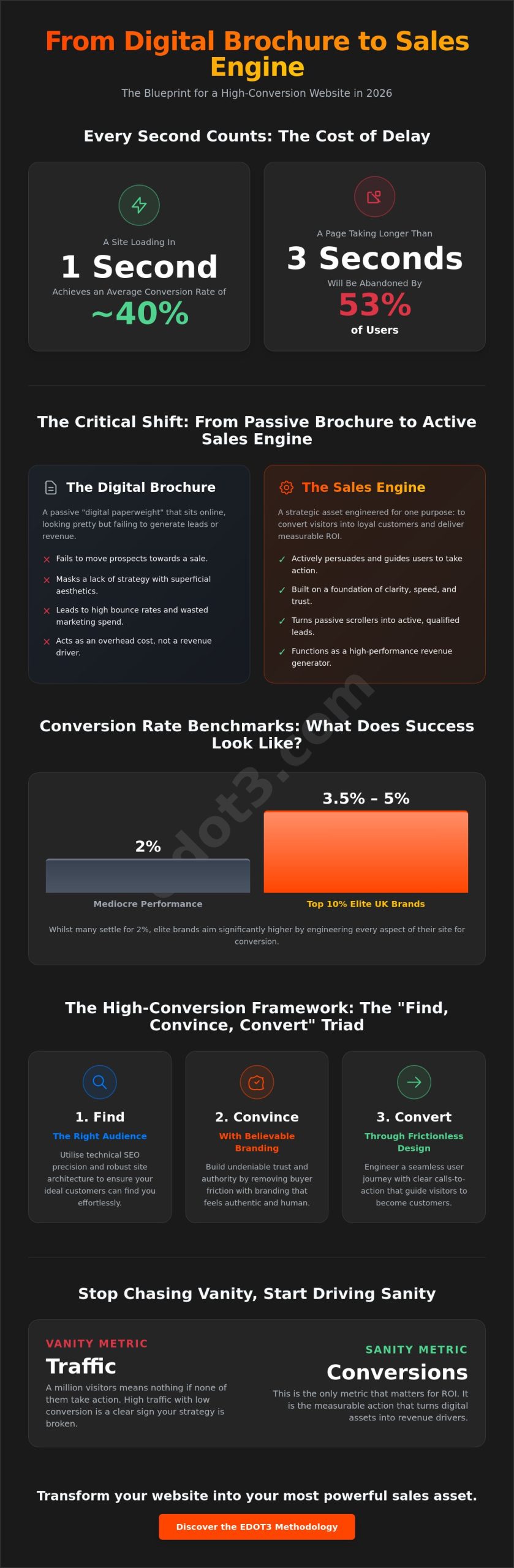
The Conversion Roadmap: Turning Passive Scrollers into Active Leads
A roadmap isn’t a suggestion; it is a requirement for growth. High conversion websites do not leave the user’s next step to chance or hope that a “pretty” design will somehow trigger a sale. Instead, they utilise a rigid, logical progression that guides a visitor from the initial spark of interest to a confirmed lead. We align your site structure with the customer journey, ensuring that every click feels like a natural evolution of the conversation. If your website feels like a maze rather than a motorway, you are actively bleeding revenue. We strip away the distractions and focus on the path of least resistance. Social proof is another area where most UK businesses are stuck in the past. Generic testimonials like “Great service!” or “Highly recommend” are a waste of pixels in 2026. They lack the specificity required to build real trust. You need data-backed success stories and verified results that address the “Convince” stage of our funnel. We also focus on reducing friction in the contact process. If your lead form asks for fifteen different pieces of information before a user can even say hello, you are killing your conversion rate. The art of an uncomplicated contact process is about asking for exactly what you need and nothing more.The Strategic User Journey
We design landing paths based on search intent. A Top of Funnel (TOFU) visitor needs education and authority, whilst a Bottom of Funnel (BOFU) visitor needs a clear, high-energy command to act. We utilise PR-SEO to build external authority that drives on-site trust before the user even arrives. By following the “Rule of Three” in our information hierarchy, we ensure your three most important value propositions are impossible to miss, preventing cognitive overload and keeping the momentum high.High-Impact Conversion Elements
Micro-copy is our secret weapon. Small changes, like switching a button from “Submit” to “Get Your Free Audit,” can result in a massive difference in click-through rates. We also implement dynamic content that personalises the experience based on where the user started. Early data from 2026 suggests that traffic from AI tools converts at an average of 5.8%, which is significantly higher than many traditional channels because these users are further along in their decision-making process. Interactive elements, such as calculators or health checks, engage users early and provide value before we ever make a pitch. If your current digital presence feels like a passive brochure rather than a sales engine, it is time to book a digital health check and fix the leaks in your funnel. We don’t do fluff; we do results.The EDOT3 Methodology: Find, Convince, and Convert for Maximum ROI
Most agencies hide behind a smokescreen of “fiddly bits” and creative fluff because they lack the technical depth to deliver real results. We don’t. At EDOT3, we have been in the game since 2007, and we have learned that high conversion websites are built on straight-talking strategy rather than superficial aesthetics. We dismiss the industry standard of “pretty but passive” in favour of exceptional foundations that actually pay the bills. When you work with us, you get Director-level contact throughout the entire process. You won’t be passed off to a transient junior employee who might disappear next month; you work with seasoned strategists who are as protective of your investment as you are. Our entry point for market dominance is the Digital Health Check. This isn’t a generic report generated by a free tool. It is our proprietary 2026 framework designed to identify exactly where your growth is leaking. We look at everything from algorithmic complexity to the emotional resonance of your branding. By identifying these gaps early, we stop the bleed and start the build. You can see the tangible results of this approach by exploring our Work, where we showcase how intelligent design and technical search engine optimisation deliver a meaningful ROI for elite UK brands.Our Six-Step Growth Process
We follow a rigid path from discovery to ROI. The process begins with Discovery, where we conduct deep research into your audience and the specific algorithmic landscape of 2026. We don’t guess; we use data to find your ideal customers. Next, we move to Strategy, crafting a bespoke digital roadmap that is designed to outpace your competition by removing every ounce of buyer friction. Finally, we move to Execution. This is where we combine high-end creativity with technical search engine optimisation to build a sales engine that is as robust as it is persuasive.Ready to Dominate Your Market?
Success in a crowded digital space requires a partner who values accountability over aesthetics. We are not just service providers; we are passionate partners who are aggressive toward your competitors and protective of your bottom line. Building high conversion websites is a technical and psychological challenge that requires seniority and a proven track record. It is time to stop settling for “good enough” and start demanding exceptional. Your journey toward market dominance starts with a comprehensive SEO and conversion audit that leaves no stone unturned. Don’t let another lead slip through a leaky funnel. You need a digital asset that works as hard as you do. Contact EDOT3 today to stop losing leads and start converting at scale with a strategy built for 2026 and beyond.Stop Leaving Your Revenue to Chance
The digital landscape of 2026 demands more than just a presence; it requires a performance. You have seen how technical authority and believable branding work together to bridge the gap between a simple visit and a confirmed lead. By prioritising exceptional foundations over superficial “fiddly bits,” you position your business as the definitive solution in a sceptical market. Mastering high conversion websites is about aligning your site architecture with the psychological needs of your audience, ensuring every click has a purpose and every page builds authority. We have been in the game since 2007, and we know that real growth happens when you stop guessing and start engineering. You need a partner who offers Director-level strategic involvement and understands the nuances of AI and PR-SEO integration. It’s time to stop watching your marketing budget vanish and start seeing a measurable ROI from your digital assets. Get Optimised For Success with an EDOT3 Digital Health Check and let’s identify the growth leaks in your current funnel. You have the tools and the roadmap; now it’s time to execute and leave your competitors behind.Frequently Asked Questions
What is a good conversion rate for a B2B website in 2026?
A strong B2B conversion rate in 2026 typically sits between 6% and 7% for professional and marketing services. Whilst retail sectors might settle for lower figures, high-value B2B leads require more intensive “Convince” stage content to build trust. If your site is languishing below 3%, you’ve likely got a fundamental issue with your digital roadmap that needs immediate attention.How long does it take to see results from conversion rate optimisation?
You’ll often see initial momentum within weeks of fixing technical errors or page speed issues, but a full cycle takes three to six months. We need enough data to move beyond guesswork and into statistical certainty. It’s a marathon, not a sprint; anyone promising overnight miracles is likely selling you fluff rather than a robust strategy.Can SEO alone improve my website’s conversion rate?
SEO finds the traffic, but it doesn’t close the deal. You can have the best search visibility in the world, but if your site is a clunky digital brochure, visitors will bounce. High conversion websites require a marriage between technical search marketing and psychological branding to turn that visibility into actual revenue.Is a custom website better than a template for high conversion?
Custom builds are almost always superior because they allow for exceptional foundations without the bloated code found in templates. Templates are often stuffed with fiddly bits that destroy your load speeds and tank your Core Web Vitals. A custom site is engineered for your specific audience journey, ensuring every pixel serves a purpose.What are the most common reasons why websites fail to convert?
Friction is the primary lead killer. Whether it’s a confusing navigation menu, a three-second page delay, or a lack of believable branding, any barrier to action will hurt you. Most high conversion websites succeed because they remove these obstacles and focus on facilitating a specific user action rather than just looking pretty.How much should a high conversion website cost in the UK?
Investment levels for digital assets in the UK vary significantly depending on the algorithmic complexity and the depth of the conversion design required. You shouldn’t view this as a one-off cost but as a strategic investment in a high-energy sales engine. Focus on the projected ROI and the seniority of the team you’re hiring rather than just the initial price tag.What role does AI play in modern website conversion?
AI is now the primary driver for identifying conversion intent and personalising the user experience. In 2026, search engines use AI Search Optimisation to determine if your site actually provides the authority users expect. Early data shows that traffic referred from AI tools converts at 5.8%, making AI-friendly site structures essential for modern growth.
Article by
Ian Shield
Director at EDOT3 since 2007