
Key Takeaways
- Understand how Google’s transition from providing simple links to executing multi-step tasks redefines your site’s structural requirements.
- Master the technical shifts within the 2026 Google Updates to remain visible whilst AI agents synthesise your content for zero-click answers.
- Learn to replace outdated keyword-stuffing tactics with “Entity Authority” and agent-friendly coding to secure your place in AI Mode.
- Discover how to conduct a rigorous “Digital Health Check” that audits your architecture for technical clarity and agentic compatibility.
- Develop a robust strategy to maintain high conversion rates by leveraging synthesised search results as a premium branding opportunity.
The Evolution of Agentic Search: What the 2026 Updates Actually Mean
The 2026 Google Updates have officially ended the era of the “ten blue links.” We’ve moved beyond simple information retrieval into a phase where the search engine acts as a doer, not just a pointer. This shift, cemented by the May 2026 Core Update, signals the rise of Agentic Search. It’s no longer about matching a string of text to a webpage; it’s about Google’s AI agents understanding a user’s complex, multi-modal intent and executing tasks on their behalf. If your strategy still relies on chasing high-volume, short-tail keywords, you’re essentially shouting into a vacuum. To grasp the scale of this change, we must look at The Evolution of Google’s Algorithms. What began as a citation index has transformed into a proactive assistant. With Gemini 3.5 Flash now serving as the default processing model, Google can handle massive context windows of over one million tokens. This allows the engine to synthesise your entire site architecture and content depth in milliseconds. This isn’t a minor tweak; it’s a total reimagining of search strategy that prioritises descriptive, multi-modal intent over the “fiddly bits” of old-school SEO. To better understand the scale of these technical shifts, watch this helpful breakdown of the latest platform changes:From Search Engine to Personal Intelligence Agent
Google now employs a “Personal Intelligence” layer that filters every result through the lens of historical user behaviour. This means two people searching for the same phrase will see entirely different agentic workflows. For businesses, the “Convince” stage of a digital journey is increasingly happening within the search interface itself. If the AI agent cannot find the structured data it needs to recommend you, you’ve lost the lead before they even click your URL. You must optimise for these Search Agents by providing authoritative, technical foundations that an LLM can trust and utilise. 2026 is the definitive turning point where high-conversion web design must satisfy both human users and AI agents simultaneously.The Impact of the Reimagined Search Box
Technical Breakdown: The May 2026 Core Update and Gemini 3.5 Flash
The May 2026 Core Update rolled out between 21 May and 2 June, marking a massive shift in how Google processes information. It isn’t just another quality tweak. By integrating Gemini 3.5 Flash as the primary engine for global search, Google has achieved what they call “Sustained Frontier Performance.” For your Technical Search Engine Optimisation, this means the crawler is no longer just looking for keywords; it’s evaluating the logic and efficiency of your entire site architecture. If your foundations are built on legacy “fiddly bits” rather than clean, structured data, you’re already behind. Gemini 3.5 Flash uses agentic coding to interpret JavaScript-heavy sites more accurately, effectively reading the “intent” behind your code rather than just the rendered output. This is a huge win for complex web applications that previously struggled with indexing. However, the data from the first month shows clear losers. Sites with bloated code and redundant scripts are being pushed aside. Google is prioritising “clean data” over superficial SEO tricks because its models need to ingest information quickly and reliably to feed the new agentic search workflows.Model-Driven Indexing and Crawl Efficiency
Gemini 3.5 Flash allows Google to process complex site architectures with significantly less energy. This efficiency gain has a direct impact on your crawl budget. If your site is slow or bloated, it’s being aggressively de-indexed in the 2026 landscape. We’re seeing a massive emphasis on Schema.org to provide “agent-readable” data structures. These structures allow AI agents to map your business entities without needing to guess. In this environment, your site’s technical health is measured by how easily an AI can navigate and understand your data without hitting a wall of unoptimised code.EEAT in the Era of Agentic Coding
Understanding AI trends to watch in 2026 is vital for staying ahead of the competition. Google’s models are now trained to detect the difference between generic “agent-generated” content and true human-led expertise. Establishing model authority now requires more than just on-page text. It demands PR-SEO and high-quality external citations to prove your brand exists and thrives in the real world. The 2026 Google Updates have made technical hygiene and brand authority non-negotiable partners in search success. The game has changed from chasing algorithms to building exceptional foundations. If your site foundations are shaky, no amount of content will save you from the next shift. It’s time to stop guessing and start building for the agentic era. If you’re unsure where your technical health stands, it might be time to get a direct evaluation from someone who understands the technical complexity of the current market.Traditional SEO vs Agentic Optimisation: A 2026 Comparison
The 2026 Google Updates have turned the old SEO playbook into a museum piece. We’ve moved from “Keyword Density” to “Entity Authority.” It’s no longer about how many times you mention a service; it’s about whether Google recognises you as the definitive authority on it. In the past, we obsessed over click-through rates. Today, success is measured by interaction-based ROI. If a user interacts with your brand via an AI agent, you’re winning, even if they don’t land on your homepage immediately. Zero-click searches are often viewed as a traffic death sentence. That’s a narrow way of looking at it. When Google’s AI synthesises your data to answer a query, it’s providing a third-party endorsement that no traditional banner ad could buy. This is a branding opportunity of the highest order. However, when a user does decide to click through, your High Conversion Web Design must be ready to close the deal. You can’t afford to waste the traffic that reaches your site on a weak, outdated interface.The New Hierarchy of Search Signals
User interaction signals now carry more weight than raw backlink volume. Google is looking for proof that users find your “agentic” responses helpful. The shift from “ranking for terms” to “becoming the recommended agent solution” is absolute. This is where Digital PR SEO becomes critical. It builds the external authority and digital footprint required for an AI model to trust your brand enough to recommend it amongst a sea of competitors. You need to be a recognised entity, not just a collection of pages.Optimising for “AI Mode” and Search Agents
To be cited in Google’s AI-generated overviews, your content must be structured for machine consumption without losing its human “wow factor.” Data transparency is the new gold standard. Your AI Search Optimisation must focus on providing clear, verifiable facts that agents can ingest. This is also where “Believable Branding” enters the Convince stage. If the AI recommends you, but your site looks like it was designed in 2015, you’ll fail the conversion. You need a cohesive journey from the search interface to the final checkout.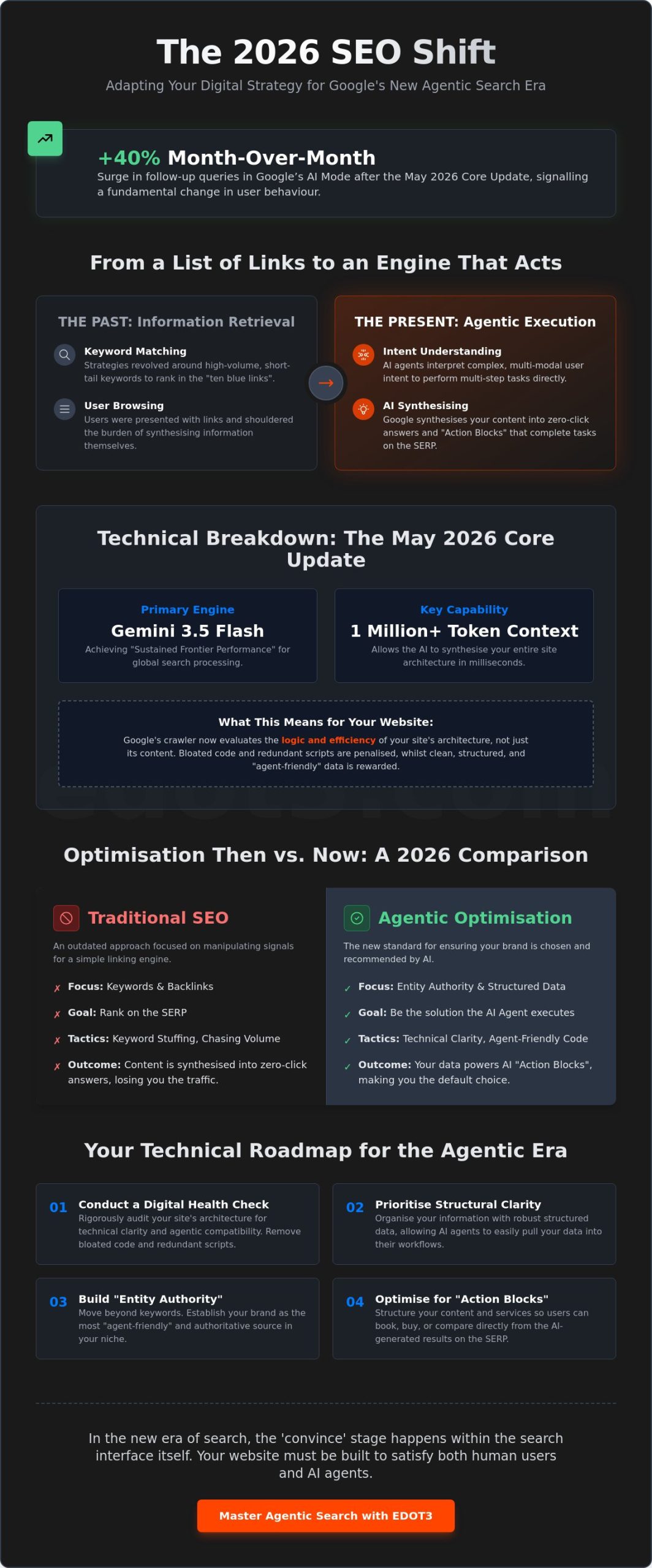
Future-Proofing Your Digital Strategy: A Technical Audit for 2026
Stop guessing about your visibility. The 2026 Google Updates require a response that goes deeper than surface-level tweaks. If your site isn’t optimised for agentic compatibility, you’re effectively invisible to the systems that now drive search. A “Digital Health Check” is no longer optional; it’s a survival requirement for any UK business that wants to remain relevant. We’re moving toward a model where traditional sessions may decline whilst conversions rise, provided your architecture is built to be “agent-friendly.” Auditing for “Agentic Coding” readiness means looking at your site through the eyes of an LLM. Does your code clearly define your entities? Is your structural clarity sharp enough for Gemini to ingest without hesitation? We’ve seen that clean data wins every time. Refining your strategy to answer “Agent-First” queries requires a shift in how you measure success. You aren’t just chasing clicks; you’re chasing the recommendation of the search agent itself.The 2026 Technical SEO Checklist
- Step 1: Validate all structured data against the latest 2026 Google Webmaster Tool standards. Use nested Schema to define relationships between your products, services, and brand authority.
- Step 2: Optimise for “Personal Intelligence” by improving user retention and engagement metrics. Google’s AI layer tracks how often users return to your brand after an agentic interaction.
- Step 3: Ensure your high-conversion web design minimises friction for search agents. If an AI agent can’t navigate your checkout or booking workflow, it won’t recommend you to the user.
Content Marketing for Search Agents
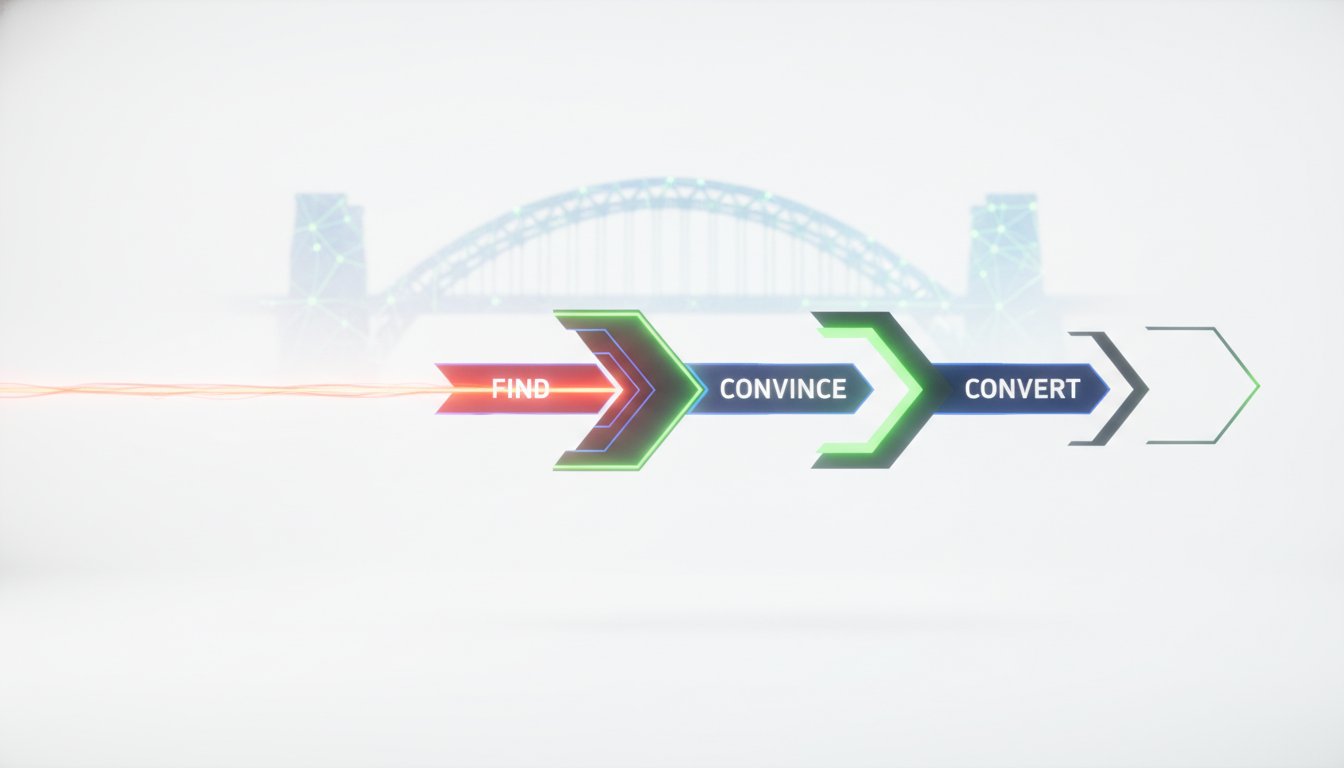
Writing for the “Find, Convince, Convert” triad in 2026 is about more than just information. You need “Believable, Loveable Branding” that influences AI model sentiment. When an agent synthesises your content, it’s looking for “exceptional foundations,” not just superficial answers. This means your content must provide deep, verifiable expertise that an AI can confidently present as a solution. Frictionless conversion design ensures that once the agent convinces the user, the final step is seamless. Measuring ROI in this new landscape requires a focus on conversion data over raw traffic numbers. You might see fewer sessions, but the users who do arrive are more qualified because they’ve already been “convinced” by the search agent. It’s a more efficient way to grow, but only if you have the technical infrastructure to support it. Ready to secure your visibility and stop wasting budget on outdated tactics? Book your Digital Health Check today and get your strategy back on track.The EDOT3 Approach: Finding, Convincing, and Converting in the AI Era
We’ve been in the game since 2007. In that time, we’ve outlasted every major algorithmic shift from the early days of Panda to the complex 2026 Google Updates. Our longevity isn’t down to luck. It’s the result of a no-nonsense, straight-talking philosophy that prioritises exceptional foundations over superficial fiddly bits. We don’t just follow trends; we build the digital road maps that allow our clients to outpace their competitors whilst others are still trying to decode the latest announcement. Success in 2026 requires a partner who understands that search has evolved into an interaction-based model. Our “Find, Convince & Convert” triad acts as the linguistic and strategic anchor for everything we do. We ensure users find you through technical precision, convince them through believable branding, and convert them with high-performance design. When you work with us, you get direct access to seniority. You’ll work with a Director who is deeply invested in your ROI, ensuring your strategy never disappears into the hands of a transient junior employee.Bespoke SEO Strategy for UK Market Leaders
We’ve mastered the art of integrating AI Search Optimisation with creative, high-impact branding. A critical part of our process is the Digital Health Check. This isn’t a generic audit; it’s a forensic deep dive designed to identify ranking leaks and technical friction before they impact your bottom line. We place a massive emphasis on “Believable, Loveable Branding” because AI agents now have preferences. An agent is more likely to recommend a brand that demonstrates consistent sentiment and authority across the web. We make sure your business is the agent’s first and only choice.Take Control of Your 2026 Search Performance
Stop reacting to updates. Start leading the conversation. The 2026 Google Updates have made the search landscape more volatile, but volatility creates opportunity for those with the right foundations. Our monthly retainer fees aren’t just for maintenance; they ensure continuous performance monitoring and rapid adjustment against AI shifts. We keep your brand rocking it whilst your competitors are still stuck in the “ten blue links” mindset. It’s time to build a presence that is both elite and accessible. Ready to master the new era of search? Read our deep dive on The Strategic Digital Agency: How to Find, Convince, and Convert in 2026 to see how we turn technical complexity into business growth. Don’t let your search strategy become a legacy relic. Get optimised for success and leave the noise behind.Master the New Frontier of Search Marketing
The 2026 Google Updates have officially moved search from a directory of links to a network of autonomous agents. Success now depends on your ability to provide clean, structured data that Gemini 3.5 Flash can ingest and recommend. We’ve explored the shift from keyword density to entity authority and the critical need for technical foundations that satisfy both AI agents and human users. If your site architecture is still stuck in the past, your brand will be left behind whilst the zero-click landscape continues to expand. EDOT3 has been rocking it as a creative digital agency since 2007, outlasting every algorithmic hurdle with our proven “Find, Convince, Convert” methodology. We don’t hide behind transient juniors; you get guaranteed Director-level contact to ensure your strategy remains sharp and results-driven. It’s time to stop worrying about declining sessions and start focusing on high-conversion authority. Get Optimised For Success with a 2026 Digital Health Check and take control of your search performance today. Your future growth depends on exceptional foundations.Frequently Asked Questions
How does the May 2026 Core Update differ from previous Google updates?
The May 2026 Core Update is unique because it integrates Gemini 3.5 Flash as the default processing model for global search. Unlike previous updates that focused primarily on content quality or link equity, this update prioritises “Sustained Frontier Performance.” It evaluates how efficiently your technical architecture can be ingested by AI agents to perform multi-step tasks. It represents a fundamental shift from a retrieval engine to a task-execution agent.What is Agentic Search and how does it affect my website traffic?
Agentic Search is the autonomous execution of user intent through LLM-driven workflows. Instead of just showing you a link to a service provider, the search engine can now execute tasks like booking or comparing directly. This affects your traffic by increasing zero-click interactions. Whilst raw session numbers might decline, the quality of traffic reaching your site is higher because the “Convince” stage has already happened within the search interface.Will Gemini 3.5 Flash make traditional SEO backlinks obsolete?
Traditional backlinks aren’t obsolete, but their role has evolved significantly following the 2026 Google Updates. Google now uses links as one of many signals to establish “Entity Authority.” Raw volume matters less than the authority and relevance of the citing source. PR-SEO and high-quality external citations are now required to prove to AI models that your brand is a trustworthy solution worthy of an agentic recommendation.How can I optimise my website for Google’s new AI Mode?
Optimising for AI Mode requires a focus on structural clarity and data transparency. You must ensure your Schema.org implementation is flawless and your site code is free of redundant bloat. AI agents need to map your business entities without friction. This means providing deep, verifiable expertise that an LLM can confidently synthesise into a response. Exceptional foundations are the only way to remain visible in these AI-generated overviews.Is my high-conversion web design still effective in 2026?
Your high-conversion web design is more important than ever, but it must now cater to two audiences. Humans still need a “wow factor” and loveable branding to feel secure. However, your design must also be technically accessible to search agents. If an AI agent cannot navigate your booking workflow or understand your pricing structure, it simply won’t recommend your business as a viable solution to the user.What should I do if my rankings dropped after the 2026 Google updates?
If your rankings dropped after the 2026 Google Updates, you need to conduct a comprehensive Digital Health Check immediately. Most drops in this era are caused by technical debt or a lack of entity clarity. Stop wasting budget on outdated keyword-stuffing strategies. Instead, audit your site for “Agentic Coding” readiness and ensure your content provides first-hand experience and expertise that AI models can clearly distinguish from generic output.Can AI agents execute purchases directly from the search results?
Yes, AI agents can now execute multi-step tasks like purchases directly through reimagined search interfaces and “Action Blocks.” This was a major theme at Google I/O 2026. For your business, this means your backend must be robust and agent-friendly. Your conversion strategy should focus on supporting these external workflows whilst maintaining a cohesive brand experience that keeps the user coming back to your brand for future needs.How do I monitor my site’s performance in an agentic search environment?
Monitoring performance in an agentic environment requires a shift from tracking sessions to tracking interaction-based ROI. You should monitor how often your brand is cited in AI overviews and the sentiment of those citations. Use Google’s updated Webmaster Tools to track agentic interactions. Ultimately, success is measured by conversion rates and brand authority rather than just the number of people who landed on your homepage.
Article by
Ian Shield
Director at EDOT3 since 2007